
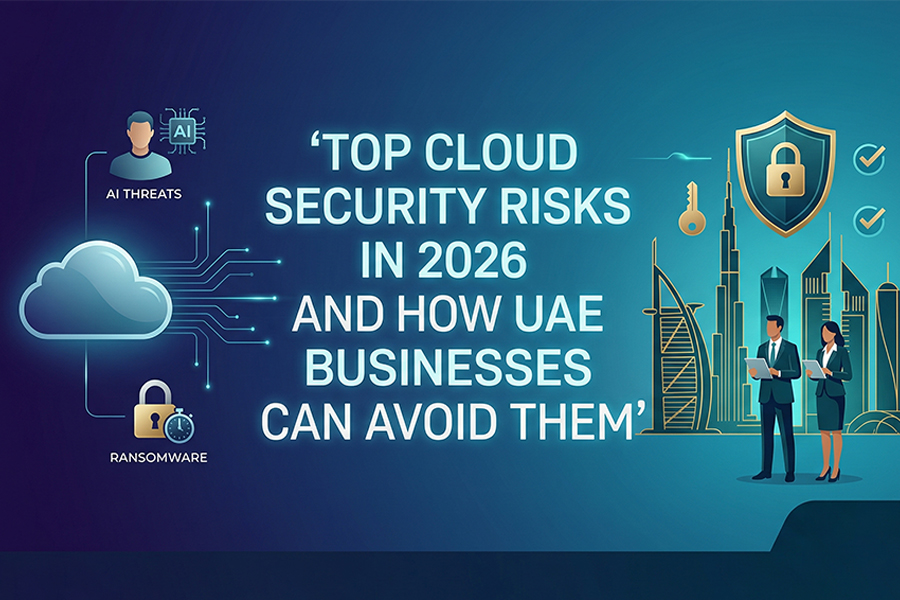
As top companies in the United Arab Emirates complete digital transformation projects at their own pace and begin using cloud computing more frequently, they are also faced with many of the same security issues. Cloud computing provides companies with many benefits (i.e., flexibility, scalability) but also introduces a host of related risks. Companies must plan ahead now in order to help protect themselves from this rapidly changing security landscape over the next 4-5 years.
The most problematic type of risk for businesses working on developing or maintaining an ongoing cloud environment will be configuration security errors; configuration errors account for the majority of cloud-based data breaches. A company could allow unauthorized users access to sensitive information simply due to improperly configured storage, security settings and/or access controls. Continuous monitoring, automated configuration management tools and a dedicated security team will help organizations mitigate risk related to cloud configuration errors.
Another rapidly growing concern will be related to user identity and access controls. In most cases, identity and access controls are how the cloud computing stack is accessed by users. Therefore, if a user has weak or reused credentials, or has too much privilege to gain access to cloud applications, it will allow an unauthorized individual to access the application. Organizations that implement a Zero Trust framework, enforce multi-factor authentication (MFA) and apply least privilege policies on identity access will protect their organization’s identity from unauthorized users.
Also, organizations face severe risks due to poor backup strategies and data loss issues. Cybercriminals could lead to complete loss of a company’s information if they do not maintain proper encryption and backup protocols in place for data at rest and in transit through encrypted transmission. Organizations looking to survive in business need to have secure and regular data backups.
Another major challenge for companies that are using several different cloud providers is the lack of visibility of the security that all these various cloud service providers have in place. With multiple cloud providers using different security measures, it can be difficult for organizations to consistently enforce and monitor security policies between multiple clouds; however, implementing centralized security management and CSPM solutions can help with this issue.
UAE companies can leverage the value of the cloud while ensuring a high level of protection by implementing safe and secure cybersecurity practices. Proactive, properly defined cloud security strategies are no longer an option; rather they are essential for sustaining growth in a digital economy.