

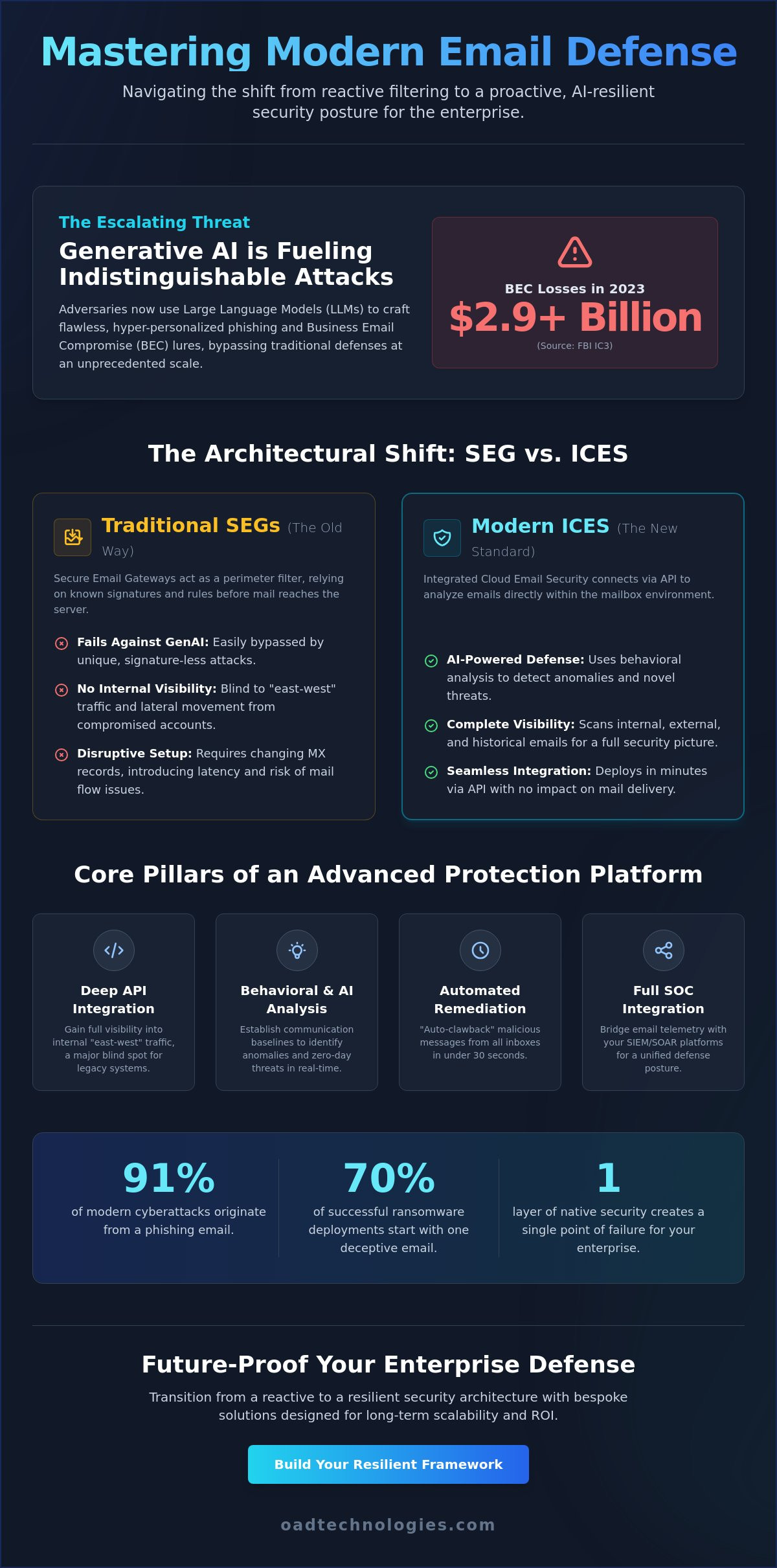
In 2023, the FBI Internet Crime Complaint Center recorded over $2.9 billion in losses due to business email compromise. By 2026, this threat will only intensify as adversaries leverage generative AI to craft indistinguishable lures at scale. You’ve likely noticed that native security tools in M365 or Google Workspace are missing these advanced, non-signature-based threats. Relying on fragmented corporate email security solutions creates dangerous visibility gaps that your team can’t afford to manage manually.
A resilient defense requires a bespoke architecture that bridges the gap between high-level innovation and practical business results. We’ve designed this framework to help you master modern email defense, protecting your enterprise from AI-driven phishing, business email compromise, and data exfiltration. This guide demonstrates how to unify your security stack through seamless integration with SIEM and EDR platforms while deploying automated incident response to ensure long-term digital relevance. We’ll examine the specific technical shifts needed to transition from reactive filtering to a proactive, AI-resilient posture.
Key Takeaways
- Identify why traditional gateways are failing against generative AI and how to transition toward more resilient, identity-centric defense layers.
- Discover the architectural advantages of API-based corporate email security solutions that provide deep visibility into internal threats without disrupting mail delivery.
- Learn how to bridge the gap between email telemetry and your SOC by integrating automated response protocols through SIEM and SOAR platforms.
- Evaluate the performance impact of ICES versus SEG models to ensure your security posture supports both operational speed and data integrity.
- Master the art of future-proofing your enterprise with bespoke security frameworks that prioritize long-term scalability and strategic business ROI.
The Evolution of Corporate Email Security in 2026
Modern corporate email security solutions have transitioned from simple perimeter filters into sophisticated, integrated platforms. These systems now synthesize threat detection, identity verification, and automated data protection into a single, cohesive architecture. This shift reflects a deeper commitment to foundational cybersecurity principles, prioritizing the resilience of communication channels that handle 91% of modern cyberattacks. Organizations no longer view email security as a standalone utility but as a core component of their broader digital transformation strategy.
Traditional Secure Email Gateways (SEGs) are proving insufficient against the current threat landscape. These legacy systems rely heavily on signature-based blocking, which fails when confronted with generative AI social engineering. Attackers now use agentic AI to probe defenses in real-time, creating unique, one-off payloads that have no historical signature. To counter this, the industry has pivoted toward behavioral analysis. By establishing a baseline of “normal” communication patterns, modern solutions can identify anomalies that suggest a compromise, even when the email contains no malicious links or attachments.
Email remains the primary vector for both ransomware and data exfiltration. In 2025, industry data indicated that nearly 70% of successful ransomware deployments originated from a single deceptive email. This reality necessitates a bespoke approach to security that integrates human intelligence with machine capability. We’re seeing a strategic move toward “Expert Architect” models where security layers are tailored to the specific operational workflows of the enterprise, ensuring that protection doesn’t come at the cost of scalability or ROI.
The Rise of AI-Driven Phishing and BEC
Attackers now leverage Large Language Models (LLMs) to eliminate the traditional red flags of phishing, such as grammatical errors or awkward phrasing. These hyper-personalized messages often mimic the exact tone of a C-suite executive, making Business Email Compromise (BEC) more difficult to detect than ever. According to 2024 FBI IC3 reports, BEC losses exceeded $2.9 billion, and that number is projected to climb as “living off the land” tactics become standard. These attacks use legitimate internal accounts and trusted tools to move laterally, effectively bypassing filters that only scan incoming external traffic.
Why Native Mailbox Security is No Longer Sufficient
While Microsoft 365 and Google Workspace provide foundational security, their built-in tools often lack the specialized depth required for high-stakes corporate environments. Relying solely on native security creates a single point of failure that sophisticated actors are trained to exploit. A robust defense in depth strategy requires an additional layer of intelligence that operates inside the mailbox environment. Integrated Cloud Email Security (ICES) represents the next generation of protection, deploying via API to analyze internal and external communications within the mailbox itself.
Core Pillars of an Advanced Email Protection Platform
Legacy secure email gateways are no longer sufficient for the sophisticated threat landscape of 2026. Modern corporate email security solutions have shifted from simple perimeter filtering to deep, API-based integration. This architectural change allows security teams to monitor internal “east-west” traffic, which is often a blind spot for traditional systems. By deploying via API, these platforms gain full visibility into the mailbox environment without the latency or configuration risks associated with changing MX records. This visibility is the foundation for automated remediation, or “auto-clawback,” where a platform identifies a malicious message and removes it from every affected inbox across the enterprise in less than 30 seconds.
Strategic defense requires more than just blocking known bad actors. According to CISA email security guidance, organizations must prioritize technical controls that verify sender authenticity and message integrity to combat evolving phishing tactics. At OAD Technologies, we view this as a transition from reactive blocking to proactive, architectural resilience. Implementing these core pillars ensures that your defense doesn’t just stop threats, but also provides the forensic data necessary for long-term strategic growth.
Behavioral Analysis and Agentic AI
Modern protection relies on agentic AI that functions as a specialized digital analyst within your environment. Unlike global threat intelligence, which focuses on broad indicators of compromise, these AI agents develop a local behavioral baseline. They learn the specific communication patterns of your organization, such as who usually talks to whom and the typical tone of executive requests. When a “look-alike” domain or a subtle shift in language occurs, the system flags the anomaly.
Explainable AI is a critical component here. A common pain point for security teams is analyst burnout; a 2023 industry survey found that 70% of SOC analysts feel overwhelmed by “black box” alerts. By providing transparent detection logic, the system explains exactly why a message was flagged. This transparency allows technical leads to make faster, more informed decisions, turning a complex security stack into a collaborative tool rather than a source of frustration.
Identity-Centric Defense and IAM Integration
Email security can’t exist in a vacuum. It must be deeply woven into your identity and access management (IAM) framework to ensure that every interaction follows Zero Trust principles. When email platforms and IAM systems share telemetry, the defense becomes significantly more robust. For example, if an employee logs in from an unrecognized IP address while their email account simultaneously starts forwarding messages to an external domain, the system recognizes this as a high-probability MFA-bypass attack.
This identity-centric approach is particularly effective against Adversary-in-the-Middle (AiTM) attacks. By analyzing behavioral anomalies in the email stack alongside login data, the platform can trigger an automatic password reset or session revocation. This level of bespoke integration ensures that your security posture is tailored to your specific operational needs. If you’re looking to refine your current architecture, our team can help you evaluate your existing email stack for these critical integration points.
Evaluating Solutions: Integrated vs. Gateway Approaches
Selecting the right architecture for your corporate email security solutions requires a choice between perimeter-based defenses and native integration. Traditional Secure Email Gateways (SEGs) act as a proxy, redirecting mail flow by modifying MX records. This process often introduces a 2 to 5 second latency per message, which can disrupt time-sensitive business operations. This legacy approach creates a single point of failure. If the gateway provider experiences an outage, your entire communication stream halts, causing immediate operational paralysis.
Modern Integrated Cloud Email Security (ICES) leverages API hooks to sit directly inside the mail environment. This allows for immediate delivery while high-speed scanning occurs in parallel. Because ICES doesn’t require MX record changes, it remains invisible to attackers who often use reconnaissance tools to identify and bypass known gateway signatures. Reviewing Gartner email security reviews reveals a significant industry shift toward these API-based models as organizations prioritize speed and resilience for 2026.
The Problem with Legacy Gateways
SEGs rely on a “castle and moat” strategy that’s increasingly ineffective. Attackers now host phishing payloads on trusted cloud services like SharePoint or AWS. Because these domains have high reputation scores, gateways often let them through without a second glance. These systems also create a massive blind spot regarding internal traffic. A 2024 analysis showed that 75% of successful account takeovers involved lateral movement via internal-to-internal email. Since a gateway only sees what enters from the outside, it can’t stop a compromised employee account from infecting the rest of the department.
The API-First Advantage for Enterprises
API-based corporate email security solutions offer a bespoke fit for modern cloud platforms like Microsoft 365. They provide post-delivery protection, which means the system can “claw back” a malicious email from every user’s inbox even after it has landed. This retrospective scanning is a game-changer for incident response. It provides rich, granular telemetry that feeds directly into your managed detection and response (MDR) ecosystem. This integration ensures that your security stack isn’t just a collection of tools, but a unified defense mechanism. ICES platforms analyze user behavior patterns to identify anomalies, such as a trusted partner suddenly requesting a change in wire transfer details, which signature-based gateways consistently miss.
- Zero Latency: Mail reaches the inbox without proxy-induced delays.
- Internal Visibility: Every internal message is scanned for lateral threats.
- Deployment Speed: Integration takes minutes, not days of DNS propagation.
- Resilience: No single point of failure in the mail delivery path.
Strategic Implementation: Integrating Email into the SOC
Email security can’t exist in a vacuum. It’s the most exploited vector in the enterprise. By 2026, 85% of successful data breaches will likely involve a human element, usually starting with a sophisticated phishing attempt. Effective SIEM integration allows email telemetry to correlate with EDR signals, creating a unified timeline of an attack. When a malicious link is clicked, the SOC sees the delivery, the execution on the endpoint, and the subsequent lateral movement attempts in one interface.
Leveraging SOAR platforms transforms this visibility into rapid action. Automated playbooks retract malicious emails from all user inboxes within seconds of a confirmed threat; this process traditionally takes hours for manual analysts to complete across large tenants. To ensure these defenses remain robust, organizations should utilize vulnerability assessment and penetration testing (VAPT) to stress-test the integration between email filters and SOC alerting.
Email as a Data Loss Prevention (DLP) Channel
Email remains a primary vector for data exfiltration. Modern data loss prevention (DLP) strategies must scan both attachments and body text for PII or intellectual property using machine learning rather than simple keyword matching. Content Disarm and Reconstruction (CDR) refers to the process of stripping potentially malicious active code from files and reconstructing them as clean, safe versions to prevent malware delivery. This ensures productivity while maintaining a strict security posture. Outbound encryption and policy enforcement must trigger automatically based on the detected data sensitivity level to prevent accidental leaks.
Automating the Analyst Workflow
The 2024 IBM Cost of a Data Breach Report highlights that organizations using extensive security AI and automation save an average of $1.76 million per incident. Integrating corporate email security solutions into the SOC reduces the “false positive” burden by approximately 40% through automated triage. Integrated platforms enable “search and destroy” missions that scan the entire tenant for specific indicators of compromise (IoCs) across thousands of mailboxes simultaneously.
User-reported phishing simulations provide a dual benefit. They train the workforce and create a feedback loop where reported emails are automatically analyzed. This provides immediate confirmation to the user and updates the global blocklist across the enterprise. This collaborative approach ensures that human intelligence and machine capability work in tandem to secure the digital perimeter.
Future-Proofing with OAD Technologies’ Bespoke Solutions
OAD Technologies operates as the Expert Architect for your organization’s digital defense. We don’t just install software; we engineer comprehensive frameworks that bridge the gap between high-level innovation and measurable ROI. In a landscape where nearly 90% of data breaches involve a human element, static defenses are obsolete. We integrate governance risk and compliance (GRC) directly into your communication channels. This ensures your strategy meets the rigorous 2026 standards for data privacy and operational integrity. We empower your team by providing transparent, sophisticated tools that enhance productivity rather than hindering it. Our focus remains on creating a secure environment where technology serves the user, not the other way around.
The Bespoke Approach to Email Defense
Standardized security often fails in complex enterprise environments because it lacks the context of your specific business logic. OAD rejects the one-size-fits-all model. We begin every engagement with a deep-dive assessment of your unique risk profile. This identifies specific vulnerabilities within your executive communication and financial workflows. Our managed services represent the perfect intersection of machine capability and human intelligence. While our AI-driven systems filter millions of data points in milliseconds, our security specialists provide the critical thinking necessary to stop sophisticated, low-volume spear-phishing attacks. This tailored approach ensures your corporate email security solutions are as unique as the business they protect, offering a level of precision that off-the-shelf products cannot match.
Achieving Long-Term Digital Resilience
Digital resilience isn’t a destination; it’s a state of constant evolution. OAD ensures your security stack grows alongside the shifting threat landscape. We provide continuous monitoring and strategic consulting to keep your defenses sharp against emerging zero-day vulnerabilities. Our partnership model focuses on scalability and seamless integration, allowing you to adopt new technologies without disrupting your core operations. By 2026, the complexity of AI-generated threats will require a partner who understands the long-term roadmap of cybersecurity. We’re committed to your digital relevance and long-term success through a “can-do” attitude backed by rigorous engineering standards. Our team acts as an extension of your own, ensuring that as your business scales, your protection scales with it. Partner with OAD Technologies to architect your corporate email security.
Architecting Your Enterprise Defense for 2026
The threat landscape is evolving rapidly. The 2024 Verizon Data Breach Investigations Report confirms that 90% of successful cyberattacks still originate through phishing attempts; this makes robust corporate email security solutions the most critical component of your 2026 digital strategy. Organizations can’t afford to rely on legacy gateways that operate in isolation. Future-proof security requires a transition toward integrated protection platforms that unify your entire defensive stack. By aligning email security with your existing SIEM, EDR, and MDR workflows, you create a synchronized response capability that significantly reduces detection times. National enterprise compliance standards now demand this level of architectural precision to safeguard sensitive data assets.
OAD Technologies acts as your Expert Architect in this journey. We don’t provide generic templates because your risk profile is unique. We build bespoke frameworks tailored to your specific operational requirements and compliance needs. Our approach ensures your security infrastructure supports strategic growth while maintaining rigorous engineering standards. Secure your enterprise with bespoke email security solutions from OAD Technologies. We’re ready to help you navigate these complexities and ensure your long-term digital resilience.
Frequently Asked Questions
What is the difference between a Secure Email Gateway (SEG) and ICES?
A Secure Email Gateway (SEG) operates as an external relay that filters traffic before it reaches your server, whereas Integrated Cloud Email Security (ICES) connects via APIs directly into the mailbox. This API architecture allows ICES to scan internal communications that SEGs typically miss. Gartner’s 2023 research indicates that 40% of organizations now prioritize ICES for its ability to detect lateral movement within a tenant.
Can corporate email security solutions prevent Business Email Compromise (BEC)?
Modern corporate email security solutions prevent Business Email Compromise (BEC) by analyzing communication patterns rather than just looking for malicious links. The FBI’s IC3 2023 report highlights that BEC caused $2.9 billion in adjusted losses. Advanced platforms combat this by using Natural Language Processing (NLP) to identify tone shifts or urgent requests that signal executive impersonation.
How does AI improve email threat detection in 2026?
By 2026, AI improves detection by moving from reactive pattern matching to proactive intent analysis using transformer models. These systems evaluate the context of every interaction in real time. Research suggests that AI-driven automation can reduce threat response times by 80% compared to manual SOC intervention. It’s a shift from identifying bad files to identifying bad behavior through deep learning.
Do I still need a third-party email security solution if I use Microsoft 365?
You need a third-party layer because Microsoft 365’s native security lacks the specialized depth required to stop 18% of sophisticated phishing attacks that bypass standard filters. While Microsoft provides a solid baseline, bespoke corporate email security solutions offer granular controls and faster updates against zero-day exploits. Relying on a single vendor creates a monoculture that attackers easily exploit.
What is DMARC and how does it fit into a corporate email security strategy?
DMARC is a protocol that ensures an email’s sender is who they claim to be. It builds on SPF and DKIM to provide a clear instruction to receiving servers on how to handle unauthenticated mail. Since Google and Yahoo’s February 2024 enforcement, DMARC has become a mandatory pillar for maintaining domain reputation and delivery. It’s the primary defense against domain spoofing.
How does email security integrate with Data Loss Prevention (DLP)?
Email security integrates with Data Loss Prevention (DLP) by inspecting outbound messages for sensitive data like Social Security numbers or proprietary code. Most systems use regex patterns to identify these 9-digit or 16-digit sequences automatically. This prevents 60% of accidental data leaks caused by employee negligence, ensuring your strategic assets remain within the corporate perimeter.
What are the key features to look for in an enterprise email security platform?
Focus on API-first architecture, automated remediation, and account takeover (ATO) protection. A robust platform should offer 99.9% detection accuracy for polymorphic malware. You also want a solution that provides human-in-the-loop feedback, allowing users to report suspicious mail directly from their inbox. This creates a collaborative defense environment that scales with your business growth.
How can I test the effectiveness of my current email security solution?
You can test effectiveness by conducting a 14 day shadow mode trial where a new solution scans mail behind your current gateway. This highlights exactly what your existing tools are missing. Industry data shows that secondary layers often catch 12% more threats during these trials. Regular phishing simulations also provide a measurable baseline for employee vulnerability and system response speed.
Disclaimer
Content by OAD Technologies is for general informational purposes only and does not constitute professional or cybersecurity advice. No warranties are made regarding accuracy or completeness; reliance is at your own risk. OAD Technologies shall not be liable for any direct or indirect losses arising from use of this content.