

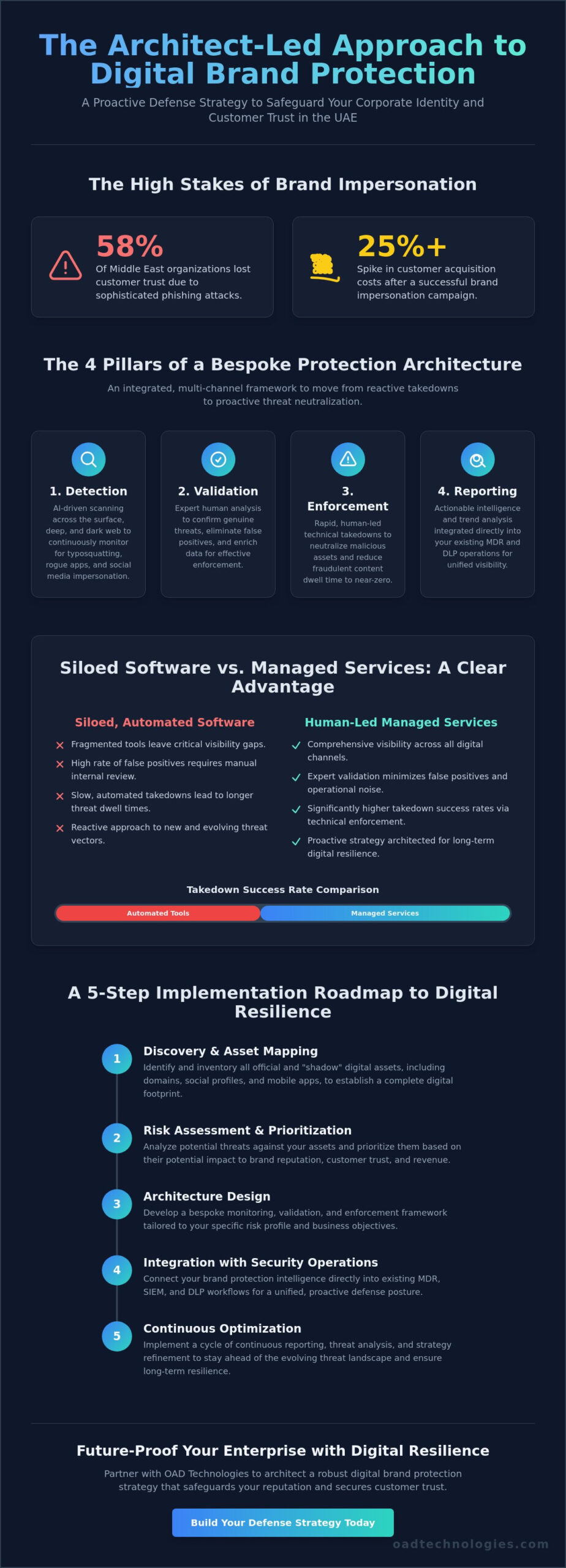
By 2026, the security perimeter of a UAE enterprise won’t be defined by a physical firewall, but by the integrity of its digital footprint across thousands of external touchpoints. A 2024 regional cybersecurity study found that 58% of organizations in the Middle East experienced a direct loss of customer trust due to sophisticated phishing campaigns that bypassed traditional filters. Relying on fragmented tools leaves gaps that attackers exploit with ease. To close these vulnerabilities, modern digital brand protection services must transition from a reactive approach to a proactive, architect-led defense strategy that treats your online reputation as critical infrastructure.
You likely recognize that slow response times from automated takedown tools are no longer acceptable when a single rogue app can damage a decade of brand equity in hours. We’ll show you how to safeguard your corporate identity and maintain customer trust through a sophisticated framework built for the specific demands of the UAE’s evolving digital market. This guide provides a blueprint for achieving comprehensive visibility across all digital channels while integrating these defenses directly into your existing MDR and DLP operations to reduce fraudulent asset dwell time to near zero.
Key Takeaways
- Understand the evolution of modern threats in the UAE market, shifting from traditional counterfeiting to sophisticated digital impersonation and phishing schemes.
- Learn how to implement a bespoke architecture for digital brand protection services built on the four critical pillars of detection, validation, enforcement, and reporting.
- Discover why human-led technical enforcement achieves significantly higher takedown success rates compared to siloed, automated software solutions.
- Master a 5-step implementation roadmap to identify “shadow” digital assets and prioritize risks based on their potential impact on your corporate reputation.
- Explore how an architect-led approach to security future-proofs your enterprise, ensuring long-term digital resilience and customer trust in an ever-changing landscape.
The Evolution of Brand Abuse: Why Digital Brand Protection Services are Essential
Digital brand protection services represent a proactive, strategic framework designed to detect and neutralize external threats targeting a company’s reputation and digital assets. This discipline has moved far beyond simple trademark enforcement. While modern brand protection once focused primarily on physical counterfeiting, the current landscape involves sophisticated digital clones and automated phishing engines. OAD Technologies views this as a critical pillar of enterprise resilience, requiring a shift from reactive legal notices to real-time technical mitigation.
The financial stakes of “brand-jacking” are substantial. When threat actors hijack a brand’s identity, they don’t just steal a single transaction; they erode the long-term trust that sustains a business. In the United Arab Emirates, where digital adoption is among the highest globally, a single successful impersonation campaign can spike customer acquisition costs by 25% or more as marketing teams struggle to regain consumer confidence. If a loyal customer in Dubai loses 15,000 AED to a fraudulent site mimicking your storefront, their lifetime value (LTV) effectively drops to zero. Protecting the brand is, therefore, a direct investment in the balance sheet.
Traditional security perimeters offer little defense against these external risks. Firewalls and endpoint protection are designed to secure the infrastructure you own, but they can’t stop a threat living on a third-party server in a different jurisdiction. Threat actors host malicious content on legitimate cloud providers or rogue domains that exist entirely outside your visibility. Without dedicated digital brand protection services, these blind spots become the primary entry points for large-scale fraud.
The Anatomy of Modern Brand Impersonation
Fraudulent domain registration remains a primary weapon for attackers. By using typosquatting techniques, such as replacing a ‘1’ for an ‘l’ in a URL, criminals create highly convincing login pages for spear-phishing. In the UAE market, we also see a rise in rogue mobile applications distributed through unauthorized third-party stores. These apps often mirror the functionality of official banking or retail tools to harvest credentials. Social media impersonation has also evolved, moving from simple fake brand pages to sophisticated “executive “clones” that target high-net-worth clients or employees through LinkedIn and WhatsApp to bypass standard security protocols.
Brand Protection as a Cybersecurity Discipline
Brand abuse is rarely an isolated incident; it’s often the initial reconnaissance stage of the cyber kill chain. By identifying and taking down a spoofed domain early, organizations prevent the delivery of malware that leads to catastrophic data loss prevention failures later. Effective defense requires viewing the brand as a technical asset that needs constant monitoring and rapid response. Digital Risk Protection (DRP) is the convergence of brand protection and threat intelligence.
Core Components of a Bespoke Brand Protection Architecture
Effective digital brand protection services operate on a four-pillar architecture: Detection, Validation, Enforcement, and Reporting. This framework isn’t static. It requires bespoke monitoring profiles that reflect the specific risk profile of your industry, whether you’re a Dubai-based fintech firm or a regional logistics giant. By integrating these pillars into a managed detection and response strategy, organizations move from reactive takedowns to proactive threat neutralization. Gartner’s analysis of brand protection software highlights how the market is shifting toward these integrated, multi-channel solutions that cover the surface, deep, and dark web. Visibility across these layers is essential for catching data leaks or counterfeit goods before they impact your bottom line.
Continuous Domain and Web Monitoring
We deploy AI-driven scrapers to scan the web for unauthorized use of corporate logos and trademarks. These tools identify visual infringements that traditional text-based searches miss. Monitoring extends to SSL certificate registrations. When a threat actor registers a certificate for a domain mimicking your corporate identity, it’s often a precursor to a phishing campaign. We analyze WHOIS data to identify threat actor clusters, often linking seemingly unrelated domains back to a single malicious infrastructure. This intelligence allows for bulk enforcement actions that save time and reduce risk. In 2024, proactive domain monitoring reduced the mean time to detect (MTTD) brand abuse by 40 percent for early adopters.
Social Media and App Store Vigilance
Social media platforms are primary vectors for impersonation. We track and identify fake profiles across LinkedIn, X, and Instagram that target your customers or employees. In the UAE, where mobile app usage is among the highest globally, detecting “cloned” apps in third-party stores is critical. These malicious apps harvest user credentials and damage brand trust instantly. Protecting the digital footprints of executives is equally vital. High-profile leaders are frequent targets for spear-phishing and reputation attacks that can devalue a company’s stock or market position. Our approach ensures that every digital touchpoint is verified and secured.
Building a resilient defense requires more than just software; it demands a partner who understands the nuances of your digital presence. You can consult with our architects to design a monitoring strategy that aligns with your specific enterprise goals for 2026.
Siloed Software vs. Managed Brand Protection Services
Enterprises often mistake a SaaS subscription for a complete defense strategy. It’s a costly error. Even though platforms like Alternative Radar can help you navigate the vast landscape of online services and software options, automated security tools frequently struggle with context. This leads to false positive rates often exceeding 35 percent, forcing internal teams to waste hours on non-threats. Professional digital brand protection services bridge this gap by layering human expertise over algorithmic scans. We don’t just identify data; we interpret intent.
Success in removing malicious content isn’t guaranteed by a bot. Automated tools often see their requests ignored by hosting providers in high-risk jurisdictions. Human-led enforcement strategies see success rates roughly 60 percent higher than automated alternatives. OAD Technologies uses a dedicated Security Operations Center (SOC) to validate every alert. We don’t just hand you a dashboard; we provide a roadmap for project success that aligns with your specific business objectives and risk appetite.
The Human Element in Takedown Enforcement
Negotiating with international registrars requires a level of finesse that algorithms haven’t mastered. Our Expert Architects navigate the legal nuances of takedown requests across various jurisdictions, including specific compliance standards in the UAE. OAD Technologies leverages human intelligence to outpace threat actors who use AI to generate thousands of unique phishing domains. By combining machine speed with human strategy, we ensure that enforcement is both rapid and permanent. This approach is vital when dealing with the TDRA (Telecommunications and Digital Government Regulatory Authority) and local domain disputes where personal relationships and technical knowledge matter more than automated scripts.
Strategic Integration with IAM and GRC
Brand protection shouldn’t exist in a vacuum. It’s intrinsically linked to identity and access management (IAM) to prevent credential abuse resulting from leaked data. When a brand’s digital footprint is compromised, it often starts with a single stolen identity or a spoofed login page. Effective digital brand protection services identify these leaks before they’re weaponized against your internal systems.
Digital risk monitoring supports governance risk and compliance (GRC) mandates by providing the audit trails required for regulatory bodies. A unified security posture reduces operational overhead and delivers a measurable ROI by consolidating fragmented toolsets. You aren’t just buying another tool; you’re investing in a bespoke architectural framework that secures your long-term digital relevance. This integration ensures that every threat detected outside your perimeter informs the security policies inside it, creating a closed-loop system of enterprise defense.
Building Your Brand Protection Roadmap: A 5-Step Implementation Guide
Transitioning from a reactive posture to a proactive defense requires a structured framework designed for the 2026 threat environment. Enterprises can’t rely on sporadic manual searches to protect their intellectual property. A resilient strategy for digital brand protection services integrates automated intelligence with human expertise to secure every touchpoint of the corporate identity.
Phase 1: Comprehensive Digital Footprint Discovery
The first step involves a rigorous audit of all digital assets. This goes beyond active websites to include dormant domains, social media handles across emerging platforms, and registered IP portfolios. We often find that 30% of an enterprise’s risk stems from “shadow” assets, such as forgotten marketing microsites created for temporary campaigns in 2022 or 2023. These unpatched sites become easy entry points for bad actors. Discovery must include third-party partner ecosystems where your brand is represented by distributors or affiliates without direct oversight. This visibility ensures no corner of the internet remains a blind spot for your security team.
Once the footprint is mapped, organizations must prioritize monitoring based on risk assessment. We categorize threats by their potential impact on revenue and reputation. For instance, a phishing site targeting UAE banking customers requires a higher priority than a low-traffic site selling counterfeit merchandise. In the Middle East, where the average cost of a data breach reached approximately AED 30 million in 2024, the financial stakes of misprioritization are too high to ignore. We configure bespoke monitoring to track trademarks, .ae domain variations, and the digital personas of key executives to ensure early detection of executive impersonation.
Phase 4: Establishing Rapid Response Playbooks
Speed is the primary metric of success when a threat is identified. Your playbook must define clear criteria for action: immediate takedown for high-risk phishing or malware distribution, versus “monitor and gather intelligence” for grey-market sellers. Effective response requires seamless coordination between legal, IT, and security teams. When a brand crisis hits, these departments shouldn’t be introduced for the first time; they should follow a pre-approved workflow. Maintaining a rigorous chain of evidence is vital for potential litigation in UAE courts or for submissions to the Telecommunications and Digital Government Regulatory Authority (TDRA). This documentation proves the origin and intent of the infringement, making the enforcement process more efficient.
The final stage is continuous optimization. The threat landscape in 2026 is dynamic, with AI-driven deepfakes and automated botnets constantly evolving. By analyzing the data from monthly incidents, we refine monitoring parameters and update enforcement protocols. This iterative process ensures your digital brand protection services remain effective against sophisticated adversaries. It transforms brand protection from a cost center into a strategic asset that preserves long-term market value.
Ready to secure your enterprise’s digital future? Explore our bespoke brand protection frameworks designed for the UAE’s unique regulatory environment.
OAD Technologies: Your Expert Architect for Digital Brand Resilience
OAD Technologies moves beyond the limitations of generic, off-the-shelf security software. We operate as your strategic partner, designing bespoke security architectures that protect your reputation from every angle. Traditional digital brand protection services often fail because they rely on static signatures; our approach evolves with the adversary. We integrate brand defense directly into your enterprise security ecosystem, ensuring seamless communication between your SIEM, VAPT protocols, and MDR services. This creates a unified front where brand intelligence informs your broader defensive posture.
Our methodology focuses on shifting your organization from a reactive state to one of proactive digital leadership. We don’t just wait for a breach to happen. We map your digital footprint and identify vulnerabilities before they’re exploited. This high-level craftsmanship ensures that your security investments yield a clear ROI by preventing the catastrophic financial and reputational costs associated with brand hijacking. By choosing a tailored framework over a one-size-fits-all tool, you’re investing in a system that respects the unique nuances of your corporate identity.
Why a National Perspective Matters for UAE Enterprises
Operating within the UAE requires a nuanced understanding of local regulations and regional threat vectors. OAD Technologies provides the advantage of a locally rooted partner that understands the specific requirements of the UAE Personal Data Protection Law (PDPL), also known as Federal Decree-Law No. 45 of 2021. We align your brand defense strategy with national standards, ensuring that data handling and incident responses meet every legal mandate. In a region where cyber threats are becoming more sophisticated, having a partner with deep local ties and global enforcement capabilities is essential for maintaining operational continuity. We bridge the gap between local compliance and international brand security.
The Future of Brand Protection: AI and Beyond
The next frontier of risk involves sophisticated synthetic media and deepfake impersonation. OAD Technologies is already deploying machine learning models designed to identify unauthorized AI-generated content that mimics your executive leadership or brand voice. We future-proof your organization by building defenses that anticipate these technological shifts. Our digital brand protection services ensure your brand remains a trusted beacon in an increasingly complex digital world. We prioritize the intersection of human intelligence and machine capability to keep your assets secure. It’s time to secure your legacy with precision-engineered defense. Schedule a strategic consultation with our Expert Architects today.
Securing Your Enterprise Legacy in the 2026 Digital Landscape
The UAE’s digital economy is on a trajectory to contribute 20% of the nation’s non-oil GDP by 2031. This rapid expansion demands a shift from reactive, siloed software toward a unified security architecture. You’ve seen how integrating Managed Detection and Response (MDR) with Data Loss Prevention (DLP) creates a resilient shield against sophisticated brand abuse. Relying on basic tools isn’t enough when 2026 threats demand a bespoke approach to digital brand protection services.
As an Expert Architect of security design, OAD Technologies understands the specific regulatory nuances and market conditions within the Emirates. We don’t just provide software; we engineer long-term resilience. Our framework ensures your defense strategy aligns with both global standards and your specific business goals. It’s time to move beyond generic solutions and adopt a strategy that scales with your corporate ambition.
Secure your corporate identity with OAD Technologies’ bespoke Brand Protection Services
Let’s build a future where your brand remains untarnished and your digital growth stays uninterrupted.
Frequently Asked Questions
What is the difference between brand protection and trademark law?
Trademark law provides the legal foundation for ownership, while brand protection is the proactive execution of those rights. Trademark law in the UAE, governed by Federal Decree-Law No. 36 of 2021, grants you legal authority over your assets. Digital brand protection services use this legal standing to monitor and remove infringements across the web. You need the law for authority; you need the service for enforcement.
How long does it typically take to take down a fraudulent website?
Most fraudulent websites are removed within 24 to 48 hours once they’re detected and reported. This timeline depends on the responsiveness of the hosting provider and the jurisdiction of the domain registrar. In the UAE, reporting malicious domains to the TDRA can accelerate the blocking process for local users. High-risk phishing sites often see a 90% takedown rate within the first day of reporting.
Can digital brand protection services monitor the dark web?
Yes, advanced services monitor dark web forums, marketplaces, and encrypted Telegram channels by indexing onion sites. They scan for leaked corporate credentials, proprietary source code, and brand-impersonation kits. Since 2023, there’s been a 40% increase in UAE-specific data sets traded on these platforms. Monitoring these hidden layers ensures you identify breaches before they reach the public internet or cause financial damage.
Is brand protection necessary for B2B companies, or just B2C?
B2B companies require brand protection just as much as B2C firms to prevent executive impersonation and supply chain fraud. While B2C focuses on counterfeiting, B2B threats often involve sophisticated man-in-the-middle attacks using look-alike domains. A 2023 industry report found that UAE B2B enterprises lost an average of 1.5 million AED per year to these targeted brand abuses and fraudulent invoices.
How does digital brand protection integrate with my existing SIEM or SOC?
Digital brand protection integrates with your SIEM or SOC through automated API feeds that deliver external threat intelligence. This allows your security team to see external brand threats alongside internal network logs in a single dashboard. By funneling verified alerts directly into your SOC, you reduce the mean time to respond to external phishing campaigns. It’s a bridge between your internal perimeter and the external web.
What are the most common types of digital brand abuse in the UAE?
The most common abuses in the UAE include domain squatting and social media impersonation targeting the financial and real estate sectors. Phishing attacks often mimic government portals or local logistics firms to steal sensitive personal data. In 2023, the TDRA blocked over 50,000 malicious websites. This highlights the scale of the threat landscape and the need for constant, automated monitoring of your digital assets.
Do I need a specific tool for social media monitoring, or is it included in a managed service?
You don’t need a separate tool because a managed service provides a bespoke, unified platform for all digital channels. While standalone tools exist, they often lack the human intelligence needed to navigate complex takedown procedures on various platforms. A managed service integrates social media monitoring with domain and marketplace scanning. This ensures you don’t have fragmented visibility or gaps in your digital defense strategy.
What is the ROI of investing in a digital brand protection service?
The ROI of digital brand protection services is measured by comparing the service cost against the potential loss from fraud and reputation damage. According to the 2023 IBM Cost of a Data Breach report, the average cost of a breach in the Middle East is 29.6 million AED. Preventing just one major phishing incident or data leak provides an immediate and substantial return on your strategic investment.
Disclaimer
Content by OAD Technologies is for general informational purposes only and does not constitute professional or cybersecurity advice. No warranties are made regarding accuracy or completeness; reliance is at your own risk. OAD Technologies shall not be liable for any direct or indirect losses arising from use of this content.