

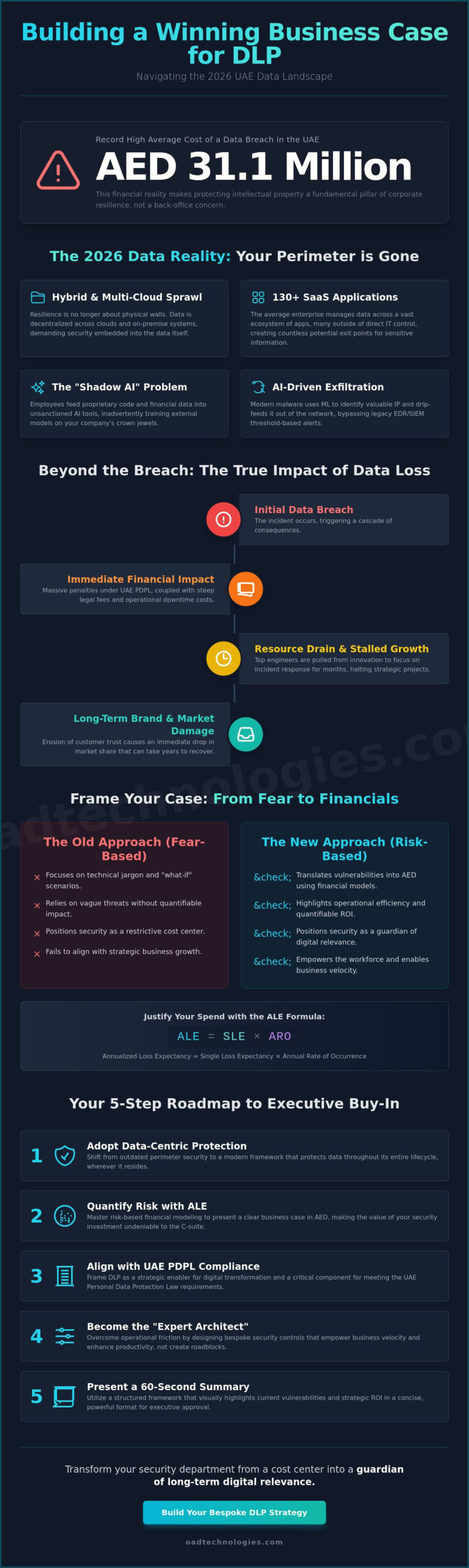
By 2024, the average cost of a data breach for organizations in the UAE reached a record high of AED 31.1 million per incident. This financial reality confirms that protecting intellectual property is no longer a back-office concern; it’s a fundamental pillar of corporate resilience. Despite this, many CISOs find that building a business case for dlp fails because it focuses too heavily on technical jargon rather than strategic growth.
You’re likely managing a complex web of hybrid and multi-cloud data while facing pushback from employees who find traditional controls too restrictive. It’s a frustrating balance to maintain. This guide bridges that gap. We’ll show you how to design a bespoke DLP strategy that secures executive buy-in by highlighting operational efficiency and quantifiable ROI. We provide the specific roadmap you need to align security protocols with your 2026 business objectives. You’ll gain the exact metrics required to prove that a sophisticated security architecture actually empowers your workforce instead of hindering their productivity. This approach transforms your security department from a cost center into a guardian of long-term digital relevance.
Key Takeaways
- Shift from perimeter-based security to data-centric protection to ensure enterprise resilience within the evolving 2026 hybrid work landscape.
- Master the transition from fear-based selling to risk-based financial modeling by calculating Annualized Loss Expectancy (ALE) in AED for your specific industry.
- Learn the strategic steps for building a business case for dlp that aligns with the UAE Personal Data Protection Law (PDPL) to drive digital transformation.
- Adopt an “Expert Architect” approach to overcome operational friction, ensuring security measures empower business velocity rather than creating roadblocks.
- Utilize a structured framework for executive approval that visualizes current vulnerabilities and highlights strategic ROI in a concise, 60-second summary.
The 2026 Data Landscape: Why DLP is No Longer Optional
The enterprise perimeter dissolved years ago. As we approach 2026, resilience isn’t about building higher walls around a physical office; it’s about embedding security directly into the data itself. Data Loss Prevention (DLP) has evolved from a simple compliance checkbox into a cornerstone of strategic architecture. It identifies, monitors, and protects information across its entire lifecycle, whether it’s at rest in a cloud bucket or in motion via an encrypted chat. Relying on legacy EDR or SIEM tools is no longer sufficient. These systems often miss the subtle context of how data moves, leaving gaps that modern attackers exploit with surgical precision.
Executives building a business case for dlp must recognize that 2026 threat vectors are defined by AI-driven exfiltration. Modern malware doesn’t just crash systems; it uses machine learning to identify the most valuable intellectual property and drip-feeds it out of the network to avoid detection by traditional threshold-based alerts. Failure to modernize results in a “reactive loop” where teams spend millions of AED on recovery rather than prevention. In a hybrid environment, the goal is to create a seamless fabric of protection that follows the data, regardless of the device or network used to access it.
The Reality of Data Sprawl in a Multi-Cloud World
SaaS growth has decentralized the corporate crown jewels. By 2026, the average enterprise manages data across more than 130 different applications, many of which are outside the direct control of IT. This sprawl is compounded by the “Shadow AI” problem. Employees frequently feed proprietary code, financial projections, or sensitive customer records into unsanctioned AI tools to boost productivity, inadvertently training external models on your private data. To counter this, organizations must move away from rigid, one-size-fits-all policies. Transitioning to a bespoke data loss prevention framework allows for granular control that recognizes the difference between a routine file share and a high-risk intellectual property transfer.
Beyond the Breach: The Hidden Costs of Data Loss
Financial impact extends far beyond the initial ransom or recovery fee. In the UAE market, a single significant data leak can trigger massive penalties under the Personal Data Protection Law (PDPL). Recent industry reports indicate that the average cost of a data breach in the Middle East has climbed toward AED 25 million when factoring in legal fees, regulatory fines, and operational downtime. The resource-heavy process of incident response often pulls your best engineers away from innovation for months at a time, stalling strategic growth.
Losing customer trust is even more expensive. In a competitive digital economy, UAE consumers are increasingly selective about who they trust with their identity. A public breach can cause an immediate drop in market share that takes years to recover. When building a business case for dlp, it’s vital to frame it as an investment in brand equity and competitive advantage. Protecting your intellectual property ensures that your unique market position remains secure from rivals who might benefit from leaked strategic roadmaps or proprietary algorithms.
Quantifying Risk: The Financial Foundation of Your Business Case
Building a business case for dlp requires moving past the “what if” scenarios of cyber attacks. Leaders in 2026 demand a risk-based financial model that translates technical vulnerabilities into AED. Instead of relying on fear-based selling, successful CSOs now use the Annualized Loss Expectancy (ALE) formula to justify security spend. This calculation multiplies the Single Loss Expectancy (SLE) by the Annual Rate of Occurrence (ARO), providing a clear figure that CFOs can compare against the cost of the software license.
Data from the Middle East suggests that the financial stakes are higher here than in almost any other region. When you cite the average cost of a data breach, it’s vital to note that Middle Eastern organizations face average costs exceeding AED 31.2 million per incident. This figure accounts for detection, notification, and the long-term loss of customer trust. By benchmarking your industry against these local 2026 projections, you ground your proposal in economic reality rather than theoretical danger.
Maximum ROI comes from identifying your “Crown Jewels.” You don’t need to protect every PDF with the same level of rigor. Focus your DLP strategy on the 5% of data that constitutes 80% of your competitive advantage, such as proprietary engineering schematics in the energy sector or private wealth data in the financial services industry. This targeted approach ensures that your initial investment yields the highest possible risk reduction per dirham spent.
The ROI of Prevention vs. The Cost of Cure
The upfront cost of a bespoke DLP architecture is often a fraction of the back-end cost of remediation. While a breach response involves forensic experts, public relations firms, and technical debt, a proactive DLP system acts as a silent filter. It significantly reduces the volume of alerts sent to your Managed Detection and Response (MDR) teams, allowing them to focus on sophisticated threats rather than accidental data leaks. Automated DLP policies eliminate the financial fallout of human error by preventing unauthorized data transfers before they occur.
Direct Savings: Insurance Premiums and Legal Fees
Robust DLP controls are no longer optional for those seeking cyber insurance in the UAE. Insurers are increasingly auditing data egress controls before setting premiums; a verified DLP implementation can lead to a 15% to 25% reduction in annual insurance costs. Beyond premiums, DLP provides a structured audit trail that streamlines legal discovery and forensic investigations. This capability helps organizations avoid the escalating fines associated with non-compliance under the UAE Data Protection Law, where penalties for negligence can be severe. If you’re looking to refine your strategy, OAD Technologies can help you architect a solution that balances compliance with operational flow.
Strategic Alignment: Mapping DLP to Growth and Compliance
Modern leaders recognize that security shouldn’t be a bottleneck. It’s a strategic facilitator. When building a business case for dlp, you’re essentially proposing a roadmap for risk-aware growth. Data Loss Prevention acts as a catalyst for digital transformation by providing the guardrails necessary for rapid innovation. It directly supports secure cloud migration by integrating with Cloud Security Posture Management (CSPM). This integration ensures that as your data moves to the cloud, its protection moves with it. Effective data classification also boosts organizational efficiency. By identifying exactly what is sensitive, teams stop wasting resources on protecting non-critical assets, allowing for better allocation of technical talent.
Strategic alignment means your security stack works for the business, not against it. A well-architected DLP solution ensures that data flows where it’s needed while staying within the boundaries of safety. It’s about creating a resilient environment where scalability and security coexist. This approach shifts the perception of DLP from a restrictive tool to a foundational element of a modern, agile enterprise.
Navigating National Compliance Standards
The UAE Personal Data Protection Law (PDPL), issued under Decree-Law No. 45 of 2021, mandates strict controls over data sovereignty and processing. DLP provides the automated monitoring required to meet these requirements without constant manual intervention. It serves as a core pillar of your Governance, Risk, and Compliance (GRC) strategy. For entities in critical sectors, DLP helps satisfy NESA and Dubai ISR mandates. These regulations aren’t just boxes to check; they’re frameworks for building trust with regional partners and international clients. By automating reporting, your team can prove compliance during audits with minimal disruption.
Enabling Secure Collaboration and Hybrid Work
Hybrid work models are now a permanent fixture in the region. In 2024, approximately 45% of UAE professionals reported working in hybrid environments. DLP allows these employees to access sensitive assets from any location without risking exposure. Bespoke DLP policies protect data in motion across collaborative platforms like Microsoft Teams or Slack. This approach moves beyond simple blocking. It uses real-time feedback to educate users. When a staff member attempts to share a restricted file, the system explains the policy. This builds a “Culture of Security” where employees become an active part of the defense strategy. When building a business case for dlp, highlighting this human-centric benefit demonstrates a commitment to both security and employee productivity.
Overcoming the Friction Objection: The Expert Architect Approach
The primary hurdle in building a business case for dlp is the fear of operational friction. Board members in Dubai and Abu Dhabi often worry that robust security will act as a handbrake on the agility required to compete in the UAE’s fast-paced economy. You must demonstrate that modern data protection doesn’t mean paralysis. A phased implementation strategy allows your organization to mature its security posture without halting daily operations. By starting with “monitor-only” modes, we gather telemetry that informs policy without blocking a single transaction.
Bespoke architectures outperform one-size-fits-all solutions because they respect the unique workflows of different departments. A legal team’s data handling needs differ vastly from those of a software engineering pod. Tailoring these controls prevents “security fatigue,” a condition where employees bypass systems that feel like obstacles. Integrating your DLP strategy with Identity and Access Management (IAM) ensures that protection is tied to the user’s role and context. This creates a seamless environment where the system verifies the user’s intent before it ever has to block an action.
Intelligent Automation and Machine Learning
Modern DLP tools have evolved beyond simple keyword matching. They now utilize advanced content and context analysis to reduce false positives by up to 45% compared to legacy systems. These platforms learn user behavior patterns to distinguish between a genuine accident and malicious intent. For instance, an employee accidentally CC’ing the wrong recipient is handled differently than a bulk export of sensitive client data. Expert Architecture balances security with usability by automating routine policy enforcement while maintaining an invisible profile for standard, low-risk business activities.
The Role of Stakeholder Engagement
Success requires more than just technical deployment. You must involve department heads during the policy creation phase to ensure the rules reflect real-world business relevance. This collaborative approach turns potential detractors into advocates. Training and awareness programs then transform employees into your first line of defense, reducing the reliance on automated blocks. During the initial rollout, use data discovery tools to identify “dark data” across your network. Showing a stakeholder exactly where their department’s sensitive files are exposed provides immediate, undeniable value and strengthens the long-term viability of your project.
Presenting the Case: A Framework for Executive Approval
The final stage of building a business case for dlp involves translating technical necessity into executive priority. Board members and C-suite leaders in the UAE operate in a high-stakes environment where compliance with the Personal Data Protection Law (PDPL) is non-negotiable. Your executive summary must distill the entire strategy into a 60-second value proposition. Focus on how data loss prevention acts as a business enabler by securing intellectual property and maintaining customer trust, rather than just a defensive cost center.
Visualizing risk is your most persuasive tool. Use the results from your initial data discovery phase to present a heatmap of current vulnerabilities. If a pilot scan identified 4,500 unencrypted files containing Emirates ID numbers or banking details on unprotected endpoints, show that data clearly. This evidence transforms abstract threats into tangible business risks. It shifts the conversation from “what if” to “what is currently happening.”
A clear, milestone-based implementation plan provides the Board with the confidence that the project is manageable. Your roadmap should follow a logical progression:
- Phase 1: Visibility (Days 1-30): Deploying discovery agents to map the data landscape.
- Phase 2: Governance (Days 31-90): Implementing classification labels and user awareness training.
- Phase 3: Prevention (Day 91+): Activating automated blocking for high-risk data movements.
The call to action must be decisive. Define the immediate next steps, such as approving the budget for a formal Proof of Value (PoV) or authorizing the selection of a strategic implementation partner. Clarity at this stage prevents the project from stalling in the approval pipeline.
Key Metrics for the Boardroom
Executive leaders prioritize Time to Value (TTV) and the Risk Reduction Percentage. Your case should demonstrate that the organization will see measurable security improvements within the first month of deployment. Contrast the Total Cost of Ownership (TCO) against the staggering costs of inaction. According to industry reports, the average cost of a data breach in the Middle East reached over AED 29 million in 2023. By showing a clear ROI through the prevention of a single major incident, the investment justifies itself. Ensure the proposed architecture is built for scalability, allowing it to integrate with your existing cloud ecosystem as your digital footprint expands.
Choosing the Right Strategic Partner
Technology alone cannot solve the data protection challenge; it requires local expertise and ongoing refinement. A specialized UAE-based firm like OAD Technologies provides the essential local context needed to navigate regional regulations and cultural nuances in data handling. We don’t believe in generic configurations. Instead, we focus on bespoke policy tuning and incident response workflows that empower your team rather than slowing them down. Managed services provide the continuous oversight required to adapt to emerging threats in the 2026 landscape.
The path to a secure digital future starts with a robust strategy. Consult with OAD Technologies to architect your bespoke DLP business case and ensure your organization remains resilient in an evolving market.
Architecting a Resilient Data Future
The transition toward 2026 demands a shift from reactive security to strategic data guardianship. IBM’s 2024 report highlights that the average cost of a data breach in the Middle East has climbed to AED 30.2 million, making the financial imperative for protection undeniable. Success hinges on moving beyond technical jargon to demonstrate how data loss prevention fuels operational efficiency and market trust. By building a business case for dlp that prioritizes high-level alignment with UAE national compliance standards, leaders can transform security from a cost center into a growth catalyst.
OAD Technologies applies an Expert Architect approach to solve these complex puzzles. We leverage a proven track record in GRC and technical security assessments to ensure your roadmap meets the rigorous demands of the UAE regulatory environment. We don’t believe in rigid, off-the-shelf software; we focus on seamless integration that empowers your team without creating friction. It’s time to move your strategy from the boardroom floor to active implementation. Secure your enterprise data with a bespoke DLP strategy from OAD Technologies and ensure your organization remains future-proof in an evolving digital economy. Your path to a secure, scalable future starts with a single, decisive step today.
Frequently Asked Questions
What is the primary difference between DLP and standard firewall protection?
A firewall acts as a perimeter gatekeeper by monitoring network traffic based on IP addresses and ports, while Data Loss Prevention (DLP) focuses on the content and context of the data itself. While a firewall prevents unauthorized access to the network, DLP ensures that sensitive information like customer IDs or financial records doesn’t leave the organization via authorized channels. It provides granular visibility into data at rest, in motion, and in use.
How does the UAE Personal Data Protection Law (PDPL) impact the need for DLP?
The UAE Personal Data Protection Law, known as Federal Decree-Law No. 45 of 2021, mandates that data controllers implement technical measures to protect personal data from unauthorized disclosure. Building a business case for dlp is essential under this law because it provides the automated discovery and protection required to maintain compliance. Non-compliance can lead to heavy administrative penalties, making DLP a critical component of a legal risk mitigation strategy in the Emirates.
Can DLP solutions prevent insider threats effectively?
DLP solutions effectively mitigate insider threats by monitoring user behavior and enforcing policies against unauthorized data transfers in real time. According to the 2023 Ponemon Institute Cost of Insider Threats Global Report, the average annual cost of insider incidents has risen to 56.5 million AED. DLP identifies when an employee attempts to upload sensitive files to personal cloud storage or copy data to external drives, blocking these actions immediately.
How long does it typically take to see ROI from a DLP implementation?
Organizations typically realize a full return on investment from a DLP implementation within 12 to 18 months. This timeline accounts for the reduction in data breach costs and the automation of manual compliance reporting tasks. A single prevented breach can save a UAE enterprise upwards of 25 million AED, which is the average cost of a data breach in the Middle East according to IBM’s 2023 report.
Will a DLP solution slow down my employees’ computers or network speed?
Modern DLP solutions don’t significantly impact system performance because they utilize optimized endpoint agents and asynchronous scanning. Most current tools consume less than 3 percent of CPU resources during active monitoring sessions. If your architecture is designed correctly, users won’t notice a change in their workstation speed or network latency. OAD Technologies prioritizes bespoke configurations that balance high-level security with seamless operational efficiency.
What are the most common mistakes when building a business case for DLP?
The most common mistake is attempting to protect all data simultaneously rather than focusing on high-value assets. Many leaders fail to involve department heads, leading to policies that disrupt legitimate workflows. Another error is neglecting the human element; 82 percent of data breaches involve a human factor according to Verizon’s 2023 Data Breach Investigations Report. A successful business case must address cultural change alongside technical deployment.
Is DLP necessary if we already have a robust EDR and SIEM stack?
DLP remains necessary because EDR and SIEM lack the deep content inspection capabilities required to identify sensitive data patterns. While EDR focuses on malicious processes and SIEM aggregates logs, DLP understands the value of the file itself. You need DLP to prevent a legitimate user from accidentally emailing a confidential PDF to the wrong recipient, a scenario that EDR and SIEM aren’t designed to stop.
How do I prioritize which data to protect first in a phased DLP rollout?
You should prioritize data based on its regulatory impact and its value to your competitive advantage. Start with personal identifiable information covered by the UAE PDPL and any proprietary intellectual property. Data discovery tools can categorize your environment, allowing you to apply strict “block” policies to 10 percent of your most critical assets first. This phased approach ensures building a business case for dlp leads to measurable wins without overwhelming your IT team.
Disclaimer
Content by OAD Technologies is for general informational purposes only and does not constitute professional or cybersecurity advice. No warranties are made regarding accuracy or completeness; reliance is at your own risk. OAD Technologies shall not be liable for any direct or indirect losses arising from use of this content.