

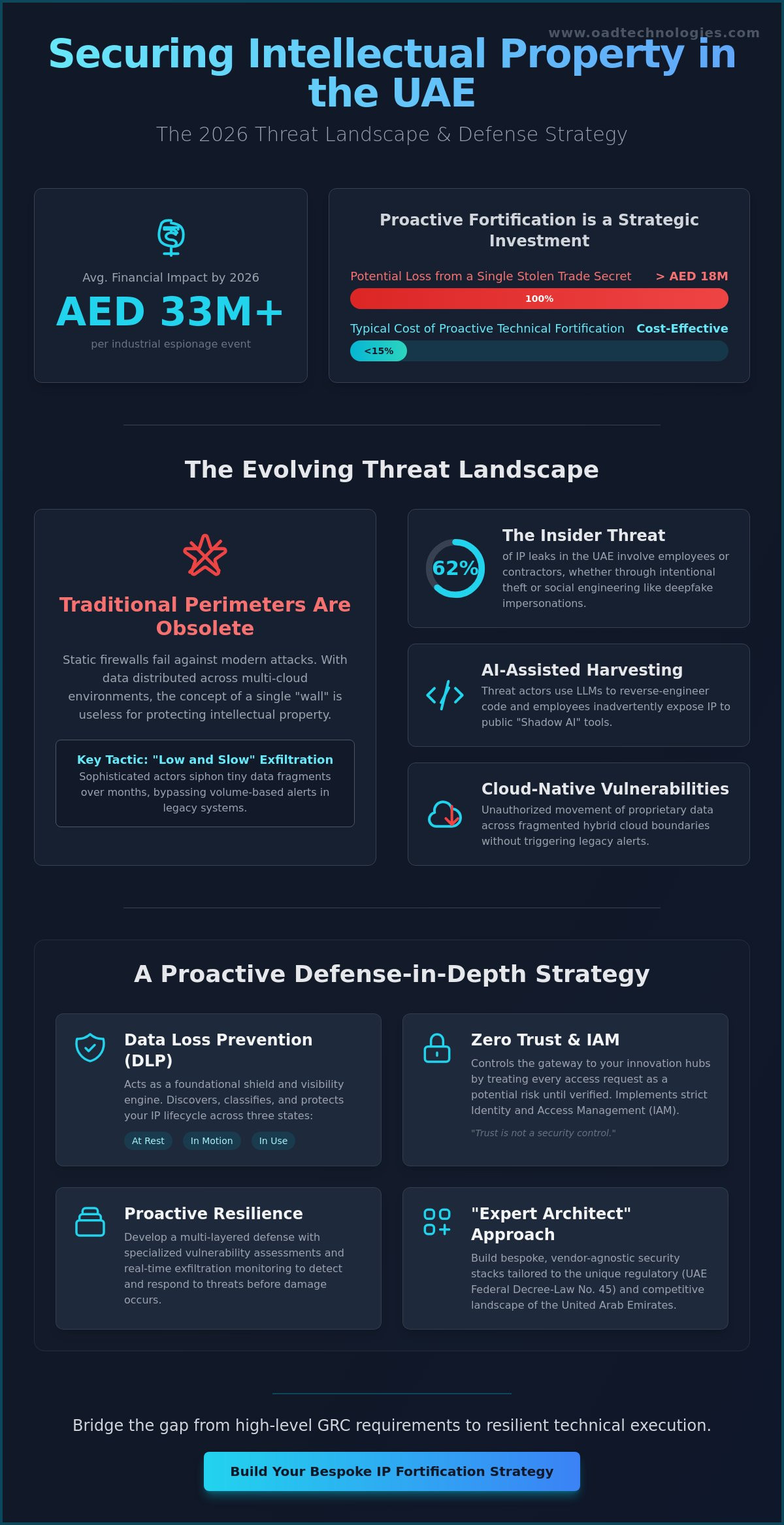
By 2026, the average financial impact of a single industrial espionage event in the UAE is expected to surpass AED 33 million, as sophisticated global actors increasingly target high-value digital assets. You’ve likely invested heavily in innovation, yet the complexity of securing intellectual property from theft in multi-cloud environments often feels like a moving target. It’s a delicate balance; you need to foster open collaboration among your engineers while preventing catastrophic data exfiltration from insider threats or external breaches.
We’ll help you master the technical and strategic frameworks required to safeguard your proprietary data against these evolving risks. You’ll gain a proactive defense-in-depth strategy that ensures your architectural designs and trade secrets remain secure without stifling your team’s productivity. This guide previews a bespoke approach to security that aligns with UAE Federal Decree-Law No. 45 of 2021, transforming your security posture from a reactive cost center into a resilient pillar of strategic growth. We’ll examine how to bridge the gap between high-level innovation and practical, future-proof business results.
Key Takeaways
- Understand why traditional perimeters are obsolete against AI-assisted harvesting and how to deploy Data Loss Prevention (DLP) as a foundational shield for your proprietary assets.
- Implement a Zero Trust architecture that utilizes Identity and Access Management (IAM) to strictly control the gateway to your organization’s most sensitive innovation hubs.
- Develop a multi-layered defense strategy for securing intellectual property from theft through specialized vulnerability assessments and real-time exfiltration monitoring.
- Learn the “Expert Architect” approach to building bespoke, vendor-agnostic security stacks tailored to the unique regulatory and competitive landscape of the United Arab Emirates.
- Bridge the gap between high-level GRC requirements and practical technical execution to ensure your enterprise’s long-term digital relevance and resilience in 2026.
The Modern Landscape of Intellectual Property Theft in 2026
By 2026, the methodology of corporate espionage has shifted from brute-force intrusions to invisible, persistent erosion. Modern Intellectual Property theft now encompasses a lethal combination of digital exfiltration, industrial espionage, and AI-assisted data harvesting. Attackers no longer aim to crash systems; they aim to clone them. In the UAE’s competitive trade hubs, the economic impact of a single stolen trade secret can exceed AED 18 million in lost market share and R&D investment. Proactive technical fortification typically requires less than 15% of that potential loss, making securing intellectual property from theft a fundamental business requirement rather than a secondary IT concern.
Traditional perimeter security is insufficient for protecting proprietary trade secrets because data no longer lives behind a firewall. Static defenses fail to stop “low and slow” exfiltration. In these scenarios, sophisticated actors siphon tiny fragments of data over months to avoid triggering volume-based alerts. This gradual drain bypasses legacy systems that were built to stop sudden, massive transfers. Businesses must recognize that the wall is gone; the focus must shift to the data itself.
Emerging Threats: AI and Cloud-Native Vulnerabilities
Generative AI tools have become double-edged swords. Threat actors now use custom LLMs to reverse engineer software code and proprietary chemical formulas by analyzing public-facing documentation and metadata. We’re also seeing a rise in “Shadow AI,” where employees inadvertently upload sensitive IP to public models to “clean up” a report or debug code. In hybrid cloud environments, IP exfiltration is the unauthorized movement of proprietary data across fragmented infrastructure boundaries without triggering legacy signature-based alerts. These vulnerabilities require a bespoke approach to oversight that balances innovation with strict data governance.
The Insider Threat: Why Trust is Not a Security Control
In 2026, the distinction between the “trusted insider” and the “external threat” has blurred. Statistics show that 62% of IP leaks in the UAE involve employees or contractors, often through a mix of intentional theft and sophisticated social engineering. Attackers leverage deepfake technology to impersonate executives, tricking staff into bypassing traditional IP safeguards. Because trust isn’t a technical control, OAD Technologies advocates for a zero-trust architecture. This shift toward data-centric security ensures that protection follows the information, regardless of who is accessing it or which device they’re using. Securing intellectual property from theft now demands that we treat every access request as a potential risk until verified by immutable data policies.
Implementing Data Loss Prevention (DLP) as your Primary Shield
In the competitive markets of Dubai and Abu Dhabi, data loss prevention (DLP) acts as the foundational technology for any enterprise serious about securing intellectual property from theft. It isn’t just a security tool; it’s a visibility engine that maps the entire lifecycle of your proprietary data. By implementing a robust DLP framework, you gain the ability to discover where your IP lives, whether it’s buried in a legacy server or circulating in a cloud-based collaboration tool. This discovery phase is vital because you can’t defend assets that remain invisible to your security team.
Effective protection requires monitoring data in three distinct states: at rest, in motion, and in use. While U.S. Government IP Resources offer a comprehensive overview of global IP standards, UAE-based firms must tailor these strategies to meet local regulatory frameworks like the UAE Federal Decree-Law No. 45 of 2021 on Personal Data Protection. We focus on a dual-layered policy approach. Content-aware DLP inspects the actual files for trade secrets, while context-aware policies analyze metadata like user behavior, file location, and destination. This ensures that your security protocols are intelligent enough to distinguish between a routine backup and a malicious exfiltration attempt.
Automated Classification and Tagging
The days of relying on employees to manually tag sensitive documents are over. Modern machine learning models now automate this process, achieving up to 95% accuracy in identifying high-value intellectual property compared to general corporate data. By utilizing digital fingerprinting, these systems recognize fragments of unique source code or bespoke engineering designs even if they’ve been reformatted or renamed. This granular level of detail allows your security team to focus their energy on the 5% of data that represents the majority of your company’s market value.
Enforcing Egress Controls Across All Channels
Securing the exit points is where the strategy meets the reality of daily operations. We integrate DLP with endpoint security to monitor email attachments, web uploads, and removable media. In 2024, a reported 58% of insider threats involved the use of personal cloud storage or encrypted messaging apps to bypass traditional firewalls. To counter this, a sophisticated approach includes blocking “print-to-PDF” functions for sensitive files and preventing unauthorized screen captures. If you’re ready to build a more resilient infrastructure, consult with our architects to design a bespoke DLP strategy that evolves with your business needs. This proactive stance is the most reliable method for securing intellectual property from theft in an increasingly digital economy.
Zero Trust and IAM: Controlling the Gateway to Innovation
The traditional network perimeter has dissolved. As UAE enterprises accelerate their digital transformation under the UAE Strategy for Government Services 2023-2026, the focus has shifted from securing office walls to securing individual identities. Modern identity and access management (IAM) represents the new frontline for securing intellectual property from theft. By treating identity as the primary security layer, organizations ensure that proprietary data remains accessible only to verified entities under specific, audited conditions.
Implementing the Principle of Least Privilege (PoLP) is the cornerstone of this strategy. For an R&D firm in Dubai or an industrial manufacturer in Abu Dhabi, this means engineers only access the specific CAD files or proprietary datasets required for their current project phase. Access is not a permanent state; it’s a temporary privilege. Just-In-Time (JIT) access models further refine this by providing elevated permissions only when necessary and for a limited duration. This approach drastically reduces the “blast radius” of a potential breach. If a single credential is compromised, the attacker finds themselves trapped in a silo rather than having free rein over the entire IP repository.
Multi-Factor Authentication (MFA) remains a non-negotiable baseline. However, 2026 standards demand phishing-resistant MFA, such as FIDO2 hardware keys, to counter sophisticated social engineering tactics targeting high-value UAE sectors.
Dynamic Access Policies for IP Repositories
Static permissions are no longer sufficient for securing intellectual property from theft in a hybrid work environment. Dynamic access policies evaluate risk-based signals in real-time, such as the user’s geolocation, the security posture of their device, and the sensitivity of the data requested. If a researcher attempts to access a proprietary chemical formula from an unrecognized network outside the UAE, the system can automatically trigger additional verification or block the request entirely. Identity serves as the critical mechanism for aligning user access with the strict requirements of UAE data sovereignty and IP protection laws.
Privileged Access Management (PAM) for Admins
Proactive Resilience: Combining VAPT, MDR, and GRC
Enterprises in 2026 can’t rely on reactive security models. True resilience comes from a multi-layered architecture that anticipates threats before they manifest as catastrophic data breaches. The first step involves conducting a specialized vulnerability assessment and penetration testing focused specifically on IP repositories. This isn’t a generic network scan; it’s a targeted hunt for weaknesses in the specific servers, databases, and local workstations where your proprietary designs or trade secrets live.
Once vulnerabilities are mapped, you must deploy managed detection and response (MDR) to catch exfiltration attempts in real-time. If a legitimate account suddenly attempts to move 50GB of encrypted CAD files to an unauthorized cloud storage bucket, MDR provides the immediate intervention needed for securing intellectual property from theft. This technical defense must align with governance risk and compliance (GRC) frameworks. This alignment ensures all technical controls meet international standards and local mandates. Finally, establish a continuous monitoring loop through SIEM integration. This aggregates logs across your entire digital estate to identify subtle patterns of unauthorized access that human analysts might miss.
Simulating IP Theft through Red Teaming
Standard pentesting often fails to address the human element of risk. Red Teaming goes further by simulating a rogue employee scenario, testing whether your internal detection systems can spot an authorized user acting with malicious intent. We’ve seen that nearly 60% of data leaks involve internal collaborators. These exercises identify critical blind spots in cloud collaboration tools like Teams or Slack, where sensitive code snippets or project plans are frequently shared without proper encryption or access oversight.
Regulatory Alignment: UAE PDPL and IP Protection
The UAE Personal Data Protection Law (Federal Decree-Law No. 45 of 2021) intersects directly with the management of trade secrets. Maintaining a Record of Processing Activities (RoPA) for sensitive IP isn’t just a best practice; it’s a legal necessity in the Emirates. Under UAE regulations, businesses must prove they’ve implemented state-of-the-art technical measures to protect data. Securing intellectual property from theft is a matter of digital survival and legal compliance. It ensures your organization avoids the heavy administrative fines associated with data negligence.
Protect your competitive advantage with a strategy built for the future. Contact OAD Technologies for a tailored IP protection roadmap designed for the UAE market.
The OAD Technologies Approach: Bespoke IP Fortification
OAD Technologies operates as an Expert Architect for your digital estate. We recognize that securing intellectual property from theft isn’t a task for generic, off-the-shelf software. Instead, we design and build tailored security stacks that align with your specific operational DNA. Our team doesn’t just deploy tools; we map your entire data lifecycle to identify where your most valuable trade secrets reside and who interacts with them. This blueprinting phase ensures that every layer of defense serves a clear, strategic purpose.
Our vendor-agnostic philosophy sets us apart from traditional integrators. We don’t push specific platforms to meet sales quotas. Instead, we objectively evaluate Data Loss Prevention (DLP) and Identity and Access Management (IAM) tools based on their ability to solve your unique challenges. This freedom allows us to select the most robust technologies available, ensuring your security stack remains agile and effective against the sophisticated industrial espionage tactics predicted for 2026. We focus on seamless integration, making sure your security measures don’t hinder the pace of your innovation.
We believe the most effective defense combines human strategic foresight with machine speed. Our approach integrates Governance, Risk, and Compliance (GRC) consulting with Managed Detection and Response (MDR). While our GRC experts ensure your security policies drive business ROI and meet international standards, our MDR capabilities neutralize threats in milliseconds. This synergy empowers your leadership team to make informed decisions while our automated systems handle the heavy lifting of real-time threat hunting.
Tailored Security for UAE Enterprises
Protecting the UAE’s digital economy is central to our mission. As the nation works toward the goals of the “We the UAE 2031” vision, national resilience depends on the ability of local enterprises to safeguard their innovations. We future-proof your IP against evolving global threats by staying ahead of regional compliance requirements and data residency laws. Our solutions bridge the gap between technical execution and business growth, turning security into a competitive advantage that attracts partners and investors who value data integrity.
Next Steps: Securing Your Competitive Advantage
The journey from vulnerability to technical resilience requires a shift from a reactive to a proactive stance. You shouldn’t wait for a breach to realize that your current data protection measures are insufficient. In a market where a single leak can cost millions of د.إ in lost revenue and reputational damage, proactive fortification is the only logical path. We invite you to move beyond basic patching and embrace a holistic security posture designed for the long term. It’s time to evaluate your current defenses and identify the gaps that could be exploited by competitors or malicious actors. You can schedule a bespoke IP security consultation with OAD Technologies to begin the process of securing intellectual property from theft and ensuring your company’s future relevance.
Building a Resilient Fortress for Your Enterprise Assets
As 2026 approaches, the methodology for securing intellectual property from theft requires more than traditional firewalls. It demands a convergence of Zero Trust architecture and specialized Managed Detection and Response (MDR) that identifies exfiltration in real time. Organizations must align their technical defenses with the UAE PDPL, specifically Federal Decree-Law No. 45 of 2021, to ensure both legal compliance and data integrity. OAD Technologies serves as a Dubai-based technical authority, providing the architectural precision needed to navigate these complex GRC frameworks. We don’t just offer software; we provide a roadmap for long-term digital relevance.
By integrating VAPT and bespoke DLP strategies, we help you transform security from a cost center into a strategic advantage. Our team understands that innovation is your most valuable currency in the Middle East’s competitive market. We’re here to ensure your proprietary data remains your own while you scale. Your path to a secure digital future starts with a partner who values craftsmanship and precision as much as you do. Let’s build a future where your ideas are protected by the highest engineering standards.
Secure your enterprise assets with a bespoke DLP strategy from OAD Technologies
Frequently Asked Questions
What is the difference between data theft and intellectual property theft?
Data theft involves the unauthorized acquisition of any digital information, while intellectual property theft specifically targets proprietary assets like trade secrets, blueprints, or patents. While data theft often focuses on personal identifiable information, IP theft aims to steal a company’s competitive advantage. A 2024 industry report indicates that 20% of UAE enterprises face targeted IP attacks annually, which results in long-term revenue loss rather than just temporary data exposure.
How does Data Loss Prevention (DLP) actually stop someone from stealing IP?
DLP software monitors and blocks unauthorized transfers of sensitive files by using digital fingerprints and content inspection. It’s a critical tool for securing intellectual property from theft because it prevents employees from uploading proprietary code to personal cloud storage or external drives. Statistics from 2025 show that firms utilizing automated classification within their DLP frameworks reduced internal data exfiltration incidents by 45% compared to those using manual processes.
Can IP theft be prevented if our data is stored in the cloud?
Yes, cloud-based IP theft is preventable through the implementation of Cloud Access Security Brokers and zero-trust architecture. Since the UAE’s push for sovereign cloud solutions in 2023, enterprises have gained better tools to apply granular encryption at the object level. These systems ensure that even if a cloud environment is compromised, the actual IP remains unreadable to unauthorized parties. It’s about controlling the access keys rather than just the storage location.
Is legal registration like trademarks or patents enough to protect my business IP?
Legal registration provides a right to litigate but doesn’t technically prevent a cybercriminal from accessing your files. While the UAE Ministry of Economy registered over 3,000 patents in 2023, these legal frameworks only help after a theft has occurred. You need a robust technical architecture to block the breach in real-time. Legal protection is your shield in court, but cybersecurity is your fortress in the digital landscape.
What are the most common signs that our IP is being exfiltrated?
Common indicators include unusual spikes in outbound network traffic or unauthorized access logs during non-working hours. A 2024 study revealed that 60% of IP theft involves insiders accessing sensitive files outside their specific job scope. You should look for large, compressed files moving to unknown IP addresses or frequent use of unauthorized USB devices. Monitoring these patterns allows your team to intervene before the data leaves your perimeter.
How does the UAE Personal Data Protection Law affect IP security requirements?
The UAE Personal Data Protection Law (Federal Decree-Law No. 45 of 2021) mandates strict security standards that indirectly strengthen IP protection. While the law focuses on personal data, the required encryption and access control frameworks create a more secure environment for proprietary assets. Non-compliance with these security mandates can lead to fines reaching AED 1,000,000, making robust cybersecurity a legal and financial necessity for Dubai-based enterprises.
What role does encryption play in securing intellectual property?
Encryption serves as the final line of defense by ensuring that stolen data is completely useless to an attacker. Implementing AES-256 encryption is a standard benchmark for securing intellectual property from theft in 2026. It protects your assets whether they’re sitting on a server or moving across the internet. If an unauthorized party intercepts your trade secrets, they’ll only see encrypted strings of characters that are impossible to decipher without your specific keys.
How often should we conduct VAPT specifically for our IP-rich environments?
You should conduct Vulnerability Assessment and Penetration Testing (VAPT) at least twice a year to maintain a secure posture. Organizations in high-growth sectors like Dubai’s tech hubs often move to quarterly testing to keep up with the 15% increase in zero-day exploits recorded in 2024. Regular testing identifies hidden vulnerabilities in your bespoke software or network configurations before they’re exploited by competitors or state-sponsored actors.
Disclaimer
Content by OAD Technologies is for general informational purposes only and does not constitute professional or cybersecurity advice. No warranties are made regarding accuracy or completeness; reliance is at your own risk. OAD Technologies shall not be liable for any direct or indirect losses arising from use of this content.