

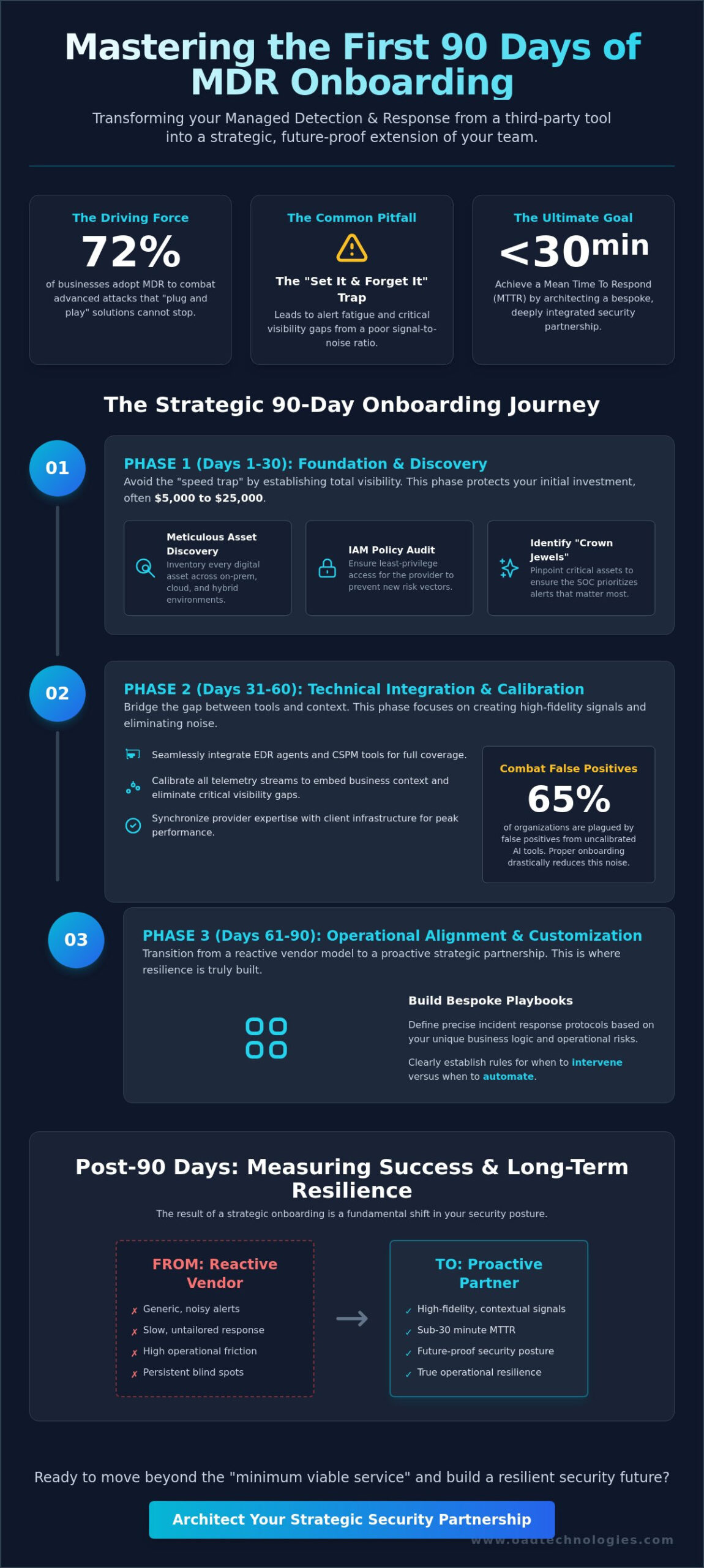
What if the greatest threat to your digital infrastructure isn’t a sophisticated exploit, but the silent failure of your security partnership during its first 90 days? Many organizations treat the transition to managed security as a simple software installation, yet 72% of businesses adopting these solutions do so to combat advanced attacks that a “plug and play” approach cannot stop. You’re likely concerned about the “set it and forget it” vendor trap or the alert fatigue that stems from a poor signal to noise ratio. Successful onboarding with an mdr service provider requires more than just technical connectivity. It demands a strategic fusion of your unique business context with advanced security telemetry to ensure long term resilience.
We’ve designed this checklist to ensure your transition is seamless and your internal IT team finally finds relief from the 24/7 monitoring burden. You’ll learn how to architect a bespoke integration that avoids downtime and sets the stage for a Mean Time to Respond (MTTR) of under 30 minutes. We will outline the specific technical milestones and operational KPIs necessary to transform your MDR from a third party tool into a high performing, future proof extension of your own team. This guide moves beyond basic setup to help you master the first 90 days of your strategic security evolution.
Key Takeaways
- Avoid the “speed trap” by conducting a meticulous asset discovery process across your entire hybrid and cloud footprint.
- Ensure seamless technical integration by calibrating telemetry from EDR agents and CSPM tools to eliminate critical visibility gaps.
- Build bespoke incident response playbooks that define exactly when your provider should intervene versus when to automate based on your business logic.
- Master onboarding with an mdr service provider by setting measurable performance baselines for detection and response within the first 90 days.
- Transition from a reactive vendor model to a proactive strategic partnership that ensures long-term operational resilience and future-proofs your security posture.
The Strategic Importance of MDR Onboarding: Beyond the ‘Speed Trap’
Speed is often the enemy of precision in cybersecurity. Many vendors push for a “rapid deployment” that promises protection within hours, but this haste frequently creates a “speed trap” where foundational security gaps are overlooked. We define Managed Detection and Response (MDR) onboarding not as a simple software installation, but as a multi-phase strategic alignment of tools, people, and processes. When you prioritize velocity over visibility, you risk inheriting a system that generates noise without providing clarity. A generic, automated setup might check a compliance box, but it won’t stop a sophisticated adversary who understands your network better than your provider does.
At OAD Technologies, we adopt the “Expert Architect” approach. This means we treat onboarding with an mdr service provider as a collaborative engineering project rather than a transactional hand-off. We bridge the gap between high-level innovation and practical results by embedding business context into every telemetry stream. Without this context, your provider cannot distinguish between a legitimate administrative script and a lateral movement attempt. With onboarding fees for enterprise integrations typically ranging from $5,000 to $25,000, ensuring this initial phase is handled with surgical precision is essential for protecting your investment and your infrastructure.
Why the First 30 Days Dictate Long-Term ROI
The initial month of a partnership determines whether you’ll achieve a high ROI or suffer from persistent operational friction. Configuration errors made during these first 30 days often lead to permanent blind spots in threat detection that aren’t discovered until a breach occurs. High-quality onboarding focuses on telemetry calibration to drastically reduce false positives, which currently plague 65% of organizations using AI-driven security tools. MDR onboarding is the process of synchronising provider expertise with client infrastructure. By getting this synchronization right, your internal IT team spends less time chasing ghosts and more time on strategic growth.
The ‘Minimum Viable Service’ vs. Strategic Resilience
Choosing a “minimum viable service” approach often involves fast-tracking EDR deployment without proper asset tagging or identity mapping. While this gets agents on endpoints quickly, it fails to provide the depth needed for true managed detection and response. Strategic resilience requires future-proofing your security stack from day one. This involves identifying your “crown jewel” assets and ensuring that your onboarding with an mdr service provider includes bespoke playbooks tailored to your specific operational risks. We believe in building a foundation that doesn’t just keep pace with modern threats but actively shapes your long-term digital relevance.
Phase 1 Checklist: Pre-Onboarding Preparation and Asset Discovery
Effective security doesn’t start with a sensor; it starts with visibility. You can’t protect what you haven’t accounted for, and a rushed discovery phase is the primary reason security gaps persist. Before the technical integration begins, you must lay a rigorous foundation. Successful onboarding with an mdr service provider hinges on the quality of your internal discovery. Start by creating a comprehensive inventory of every digital asset across your on-prem, cloud, and hybrid environments. This isn’t just a technical list; it’s a map of your business operations. Protecting an investment that often includes upfront onboarding fees ranging from $5,000 to $25,000 requires surgical precision during this phase to ensure total coverage.
You must also audit your existing identity and access management (IAM) policies. Ensuring least-privilege access for your provider prevents the security solution itself from becoming a vector for risk. Identifying your “Crown Jewels”—the specific databases, intellectual property, or customer-facing applications that require the highest priority monitoring—allows the SOC to prioritize alerts that matter most. We recommend using a structured MDR deployment checklist to ensure no critical system is left in the shadows. This level of preparation is what separates a standard setup from a truly strategic onboarding with an mdr service provider.
Critical Asset Mapping and Risk Prioritisation
Categorize assets by business impact rather than technical type. A server holding non-sensitive logs shouldn’t have the same priority as your primary ERP system or financial database. Aligning this list with your governance risk and compliance (GRC) requirements ensures your security posture meets both technical and regulatory standards. Before granting any SOC access, verify that every high-risk account has multi-factor authentication (MFA) enabled. This simple step secures the integration point and prevents unauthorized access to your telemetry streams.
Establishing Operational Communication Protocols
In a UAE business context, it’s vital to define the nuance between “Urgent” and “Critical” notifications. Urgent might mean a potential policy violation, while Critical signifies an active ransomware attempt. Assign internal stakeholders for 24/7 emergency contact to ensure you meet the industry benchmark of a Mean Time to Respond (MTTR) under 30 minutes for critical alerts. Clear communication protocols are the foundation of rapid incident response. If you’re unsure how to structure these hierarchies, our team can help you architect a bespoke communication strategy that fits your organizational flow.
Phase 2 Checklist: Technical Integration and Telemetry Calibration
Once you have mapped your digital estate, the technical engineering phase begins. This is where the theoretical architecture becomes operational reality. Onboarding with an mdr service provider requires a meticulous rollout of Endpoint Detection and Response (EDR) agents across your entire fleet. This isn’t a “one size fits all” deployment; it requires specific configuration for legacy systems, mobile devices, and high-performance servers. Simultaneously, your team must validate log ingestion from firewalls, email gateways, and network sensors to ensure no telemetry stream is left disconnected. A fragmented data stream leads to fragmented security.
Tuning the signal-to-noise ratio is perhaps the most critical technical task in this phase. With 65% of MDR vendors now utilizing AI-driven analytics, the risk of alert fatigue is high if the system isn’t calibrated to your specific environment. We focus on identifying actionable threats while suppressing the background noise of routine administrative tasks. This precision ensures that when an alert reaches your console, it represents a genuine risk rather than a false positive. High-quality calibration allows your internal team to focus on strategic growth rather than triaging thousands of low-priority events.
Telemetry Synchronisation and Signal Tuning
To avoid “Log Fatigue,” you must filter out non-essential events at the source before they saturate your bandwidth or overwhelm the SOC. This requires deep visibility into encrypted traffic and a strategy for identifying shadow IT that may be bypassing your standard controls. A vital checklist item during this stage is to confirm that your data loss prevention (DLP) alerts are correctly mapped to the MDR incident console. This ensures that data exfiltration attempts are treated with the same urgency as malware infections, bridging the gap between endpoint security and data integrity.
Cloud and Hybrid Environment Mapping
Integrating logs from AWS, Azure, or Google Cloud requires a clear understanding of the Shared Responsibility Model. During onboarding with an mdr service provider, you must define exactly where the cloud provider’s security ends and your MDR provider’s monitoring begins. This involves integrating telemetry from CSPM tools to monitor for misconfigurations in real-time. Finally, verify that EDR agents are functioning correctly within virtualised or containerised environments. These modern architectures often require specialized drivers or sidecar configurations to maintain the visibility necessary for autonomous investigation agents to perform root-cause analysis.
Phase 3 Checklist: Operational Alignment and Playbook Customisation
Establishing a technical connection is only half the battle. The true value of onboarding with an mdr service provider lies in the rules of engagement. You must transition from raw telemetry to operational intelligence by developing bespoke Incident Response (IR) playbooks. Generic, “one size fits all” templates often fail because they don’t account for your specific business logic or risk appetite. If an automated system isolates a critical production server during peak hours due to a misinterpretation of routine maintenance, the resulting downtime can be more damaging than the threat itself. We believe in a collaborative architecture where response actions are tailored to your unique operational flow.
Before your service goes live, you must conduct a rigorous Tabletop Exercise. This simulation tests the newly established onboarding workflow against a real world breach scenario. It ensures that communication channels are clear and that your internal team knows exactly what to expect when the SOC triggers an escalation. This phase is about building trust in the system’s ability to act with surgical precision. By defining automated response actions versus manual intervention requirements early, you ensure that your security posture remains resilient without sacrificing business continuity.
Customising Playbooks to Business Logic
A static playbook is a liability during a sophisticated ransomware attack. Your IR strategy should be a living document that integrates findings from your most recent vulnerability assessment and penetration testing (VAPT). This allows the SOC to prioritize threat hunting in the areas where your defenses are statistically most likely to be tested. A vital checklist item for this stage is documenting a list of “Excluded Actions.” These are your most sensitive systems where the provider must never automate a response, such as host isolation, without explicit manual approval from your designated internal leads.
Compliance and GRC Reporting Alignment
In the UAE, security operations must align with strict national regulatory frameworks. Your onboarding with an mdr service provider must ensure the platform can generate reports specifically formatted for NESA, ISO 27001, or UAE PDPL audits. We map threat detection categories directly to these regulatory requirements to provide the C-suite with automated compliance dashboards. This transparency transforms your security data into a strategic asset that proves your commitment to global standards. If you need to bridge the gap between technical defense and regulatory adherence, consult with our GRC architects to design a reporting structure that meets your specific obligations.
Measuring Success: The First 90 Days Post-Onboarding
The conclusion of your technical setup marks the beginning of your operational optimization. The first 90 days following your onboarding with an mdr service provider serve as a critical validation period. This is when you determine if the architectural decisions made during the discovery phase are delivering the promised resilience. You must move beyond the simple “is it working?” and ask “how well is it protecting us?” By evaluating your Mean Time to Detect (MTTD) and Mean Time to Respond (MTTR) against your initial baselines, you can quantitatively measure the impact on your security posture. Achieving the industry benchmark of an MTTR under 30 minutes for critical alerts is the primary goal of this phase.
Reviewing the quality of threat hunting reports is equally vital. These shouldn’t be generic logs but proactive insights based on emerging threat intelligence. For the 54% of SMEs that adopt MDR due to limited internal resources, the most significant metric is the reduction in internal IT workload. If your team is still drowning in alerts, the “signal-to-noise” tuning from Phase 2 requires further refinement. Scheduling your first Quarterly Business Review (QBR) allows you to use real-world data to sharpen your detection logic and ensure your provider is acting as a true extension of your team.
Key Performance Indicators (KPIs) for MDR Maturity
Success in managed security is defined by risk reduction rather than just a tally of blocked threats. While competitors focus on high volumes of low-value alerts, a mature partnership prioritizes operational efficiency and strategic growth. You should audit the first five “Critical” incidents to verify playbook accuracy and response speed. Did the SOC adhere to the “Excluded Actions” you documented? Was the communication flow seamless? These KPIs provide the concrete data you need to justify your security investment to the board, turning a technical expense into a documented driver of long-term ROI.
The OAD Technologies Advantage: Future-Proofing Your Security
Our approach as an “Expert Architect” ensures that your onboarding with an mdr service provider isn’t a static event. We understand the specific nuances of the UAE threat landscape, where regional targets often face unique adversarial tactics. As your digital footprint expands through transformation and scalability, our bespoke solutions evolve alongside you. We bridge the gap between machine capability and human intelligence to provide a guardian that secures your long-term digital relevance. Secure your enterprise with OAD Technologies’ bespoke MDR services today.
Architecting Your Long-Term Security Resilience
The transition to managed security is a strategic evolution that requires surgical precision at every stage. You’ve seen that successful onboarding with an mdr service provider relies on bridging the gap between technical telemetry and your unique business logic. By prioritizing asset discovery and customizing playbooks during the initial setup, you ensure that your provider delivers proactive threat hunting rather than reactive noise. This rigorous foundation allows your internal team to shift focus toward strategic growth while maintaining a Mean Time to Respond (MTTR) of under 30 minutes for critical alerts.
As your Expert Architect, OAD Technologies provides the Dubai-based expertise necessary to navigate complex UAE regulatory standards like NESA and the PDPL. We specialize in bespoke integrations that prioritize your “Crown Jewel” assets through a proven 24/7 SOC capability powered by advanced SIEM and EDR telemetry. Our goal is to ensure your infrastructure remains future-proof and resilient against an ever-changing threat landscape. Partner with the Expert Architects at OAD Technologies for Bespoke MDR Onboarding and secure your enterprise’s digital relevance today.
Frequently Asked Questions
How long does onboarding with an mdr service provider typically take?
Onboarding with an mdr service provider typically takes between 30 and 90 days to achieve full operational maturity. The first 14 days focus on asset discovery and preparation, while the following month involves technical deployment and telemetry calibration. This deliberate pace prevents the “speed trap” of visibility gaps. We ensure your security architecture is built for long term resilience rather than just meeting an arbitrary deadline.
Will my network experience downtime during the MDR onboarding process?
No, your network will not experience downtime during the integration phase. Modern Endpoint Detection and Response (EDR) agents are designed for silent, non-disruptive deployment across your fleet. We schedule telemetry validation during low-traffic windows to ensure zero impact on your business continuity. This seamless integration allows your team to maintain productivity while we architect your new 24/7 security perimeter.
What internal resources do I need to allocate for a successful MDR transition?
You should allocate an IT lead for technical configuration and a business stakeholder to provide risk context. A successful transition requires approximately 5 to 10 hours of internal staff time per week during the initial 30 day period. These resources are essential for defining your “Crown Jewel” assets and ensuring that our bespoke playbooks align with your internal operational workflows and escalation hierarchies.
Can I onboard an MDR provider if I already have an existing SIEM or EDR tool?
Yes, you can leverage your existing SIEM or EDR tools during the integration process. We specialize in multi-vendor environments and can ingest telemetry from your current stack to enhance our detection capabilities. This approach protects your previous technology investments while adding our expert human intelligence and 24/7 monitoring. It’s a strategic fusion that maximizes your current ROI while future-proofing your security posture.
What happens if the MDR provider detects a threat during the onboarding phase?
Incident response begins the moment your telemetry becomes live in our SOC. If a threat is detected during the onboarding phase, we trigger our emergency response protocols immediately. We don’t wait for the full 90 day maturity period to protect your infrastructure. Our “Expert Architect” approach ensures that active investigation and remediation are available as soon as the first sensor is successfully deployed and validated.
How does MDR onboarding differ for cloud-native vs. hybrid environments?
Cloud-native onboarding focuses on API integrations and CSPM tools, whereas hybrid environments require a mix of agent deployment and log ingestion from on-prem sensors. Cloud environments allow for faster telemetry synchronization, but hybrid setups require more meticulous mapping of lateral movement paths. We tailor the onboarding with an mdr service provider to match your specific architecture, ensuring total visibility across every digital asset you own.
Is it necessary to customise incident response playbooks for every client?
Yes, custom playbooks are essential to avoid catastrophic business interruptions. A generic response might isolate a critical production server that handles 90% of your transactions, causing more damage than a minor malware infection. We build bespoke playbooks that reflect your unique business logic and risk tolerance. This precision ensures that automated actions only occur where they are safe and manual intervention is prioritized for your most sensitive systems.
How do I measure the ROI of my MDR service in the first three months?
You measure ROI by tracking the reduction in Mean Time to Respond (MTTR) and the decrease in internal IT workload. Organizations typically see a 60% reduction in time spent on security triaging within the first 90 days. Additionally, having documented 24/7 monitoring can help you meet cyber insurance requirements and potentially reduce premiums. These metrics provide clear evidence of the strategic value and operational efficiency gained through the partnership.
Disclaimer
Content by OAD Technologies is for general informational purposes only and does not constitute professional or cybersecurity advice. No warranties are made regarding accuracy or completeness; reliance is at your own risk. OAD Technologies shall not be liable for any direct or indirect losses arising from use of this content.