

The most expensive security audit might be the one that leaves your digital assets most exposed. Many UAE enterprises find themselves caught in a cycle of “compliance theater,” where overlapping vendor terminology obscures the real gaps in their defense. You likely feel the mounting pressure to align with the UAE PDPL and ISR standards while justifying every dirham of your security budget. Understanding the precise nuances of vulnerability assessment vs penetration testing is no longer just a technical requirement; it’s a strategic necessity for maintaining operational resilience in 2026. According to the 2023 IBM Cost of a Data Breach Report, the average cost of a breach in the Middle East reached AED 29.6 million, making precision in your security spend more critical than ever.
We’ll help you move past the confusion to master the critical distinctions between automated scanning and human-led exploitation. You’ll gain a clear framework for prioritizing security activities based on actual risk rather than generic checklists. This guide provides a roadmap to integrate these tools into a bespoke VAPT strategy that protects your ROI and ensures your organization’s long-term digital relevance in an increasingly complex threat landscape.
Key Takeaways
- Understand how the evolving UAE threat landscape and national data protection mandates necessitate a proactive shift toward advanced security validation.
- Learn how to implement automated vulnerability scanning as a scalable, wide-angle lens for identifying known CVEs across your entire digital infrastructure.
- Explore the surgical application of penetration testing to simulate real-world adversary tactics and pressure-test your defense resilience.
- Identify the critical distinctions in scope and frequency when evaluating vulnerability assessment vs penetration testing to build a future-proof security roadmap.
- Discover how to transition from commodity services to a bespoke VAPT strategy that bridges the gap between technical discovery and strategic business results.
The Evolution of Technical Assessments in the UAE Threat Landscape
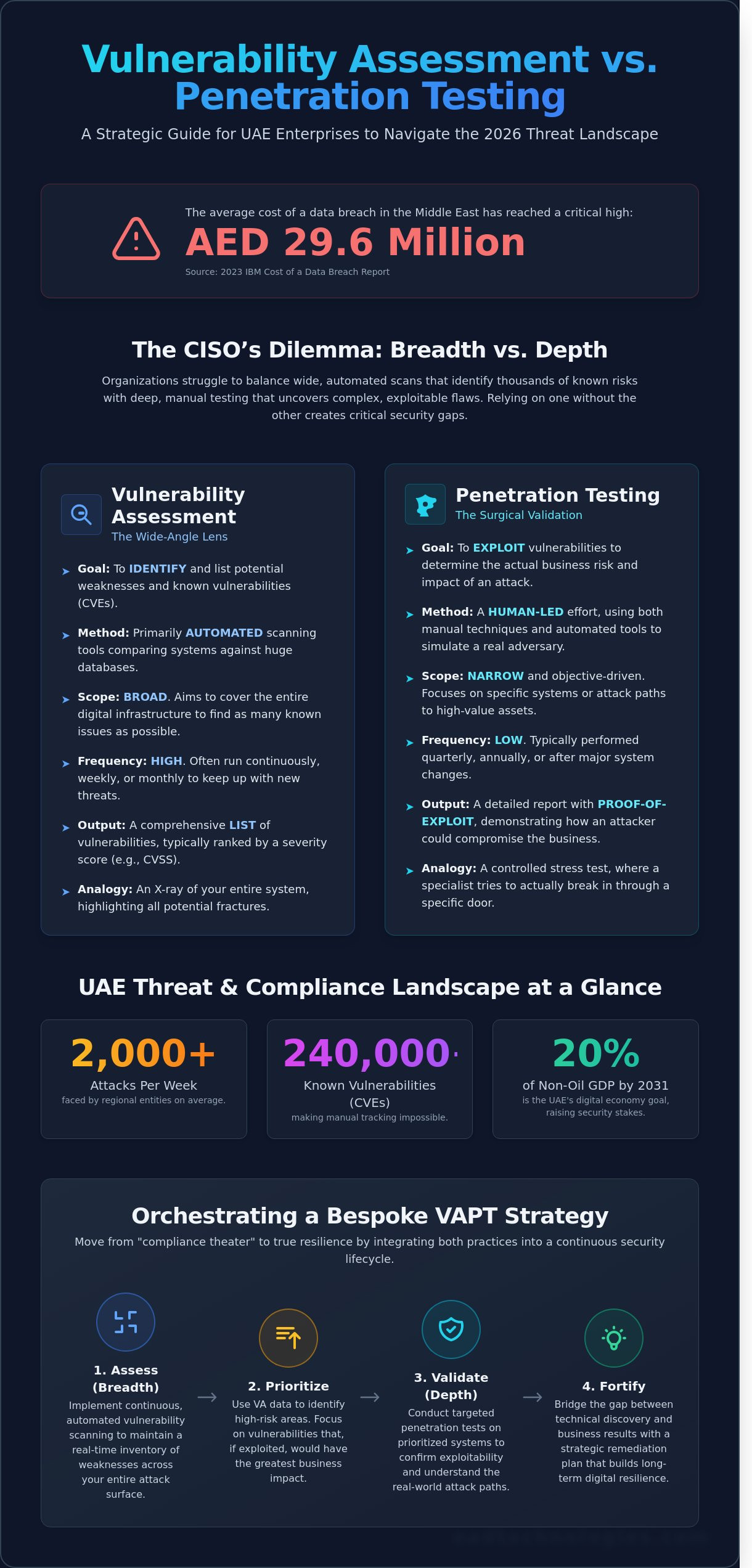
The UAE’s digital economy is projected to contribute 20% to the non-oil GDP by 2031, a goal that has transformed cybersecurity from a back-office function into a boardroom priority. By 2026, the distinction between vulnerability assessment vs penetration testing has become a critical operational divide. While a vulnerability assessment focuses on the proactive discovery of weaknesses across an expansive surface area, a penetration test provides the active validation of security controls by simulating real-world attacks. Organizations can’t afford to confuse the two.
The stakes for UAE enterprises have never been higher. With the full enforcement of national data mandates, the era of “checking the box” for annual audits is over. Static security snapshots fail to capture the volatility of a landscape where regional entities faced an average of 2,000 attacks per week in recent years. We view VAPT not as a one-off event, but as a continuous lifecycle. This approach ensures that as your infrastructure scales, your defenses evolve in parallel, transforming security from a reactive cost center into a strategic business enabler.
The CISO’s Dilemma: Breadth vs. Depth
Many organizations struggle to balance the wide-reaching nature of automated scanning with the deep, manual rigor required for true testing. Automated tools often provide a false sense of security by identifying thousands of low-level risks while missing the complex logic flaws that sophisticated regional threat actors exploit. Technical assessments serve as the non-negotiable foundation for safeguarding the UAE’s national digital infrastructure against increasingly autonomous cyber threats. Moving beyond simple scans allows CISOs to prioritize remediation based on actual business risk rather than arbitrary severity scores.
Regulatory Drivers for Technical Validation
Compliance is a primary catalyst for technical rigor in the Emirates. Aligning your strategy with the UAE Personal Data Protection Law (PDPL) requires more than just policy; it demands technical proof of data residency and protection integrity. VAPT serves as a cornerstone for Governance, Risk, and Compliance (GRC) by providing the empirical evidence needed to meet Information Assurance (IA) frameworks.
- PDPL Compliance: Validating that personal data remains shielded from unauthorized exfiltration.
- IA Standards: Meeting the rigorous technical validation requirements set by the UAE Cyber Security Council.
- Risk Quantification: Converting technical findings into financial risk metrics that resonate with stakeholders.
As we head toward 2026, the integration of vulnerability assessment vs penetration testing into a unified risk management strategy is the only way to ensure long-term digital resilience. It’s about building a bespoke security architecture that’s as ambitious as the UAE’s own digital future.
Vulnerability Assessment: The Wide-Angle Lens on Digital Weakness
Vulnerability assessment (VA) acts as the high-frequency radar of a modern cybersecurity strategy. It utilizes automated scanning engines to systematically identify known security holes, unpatched software, and configuration errors across an organization’s entire digital estate. While the vulnerability assessment vs penetration testing debate often centers on which is “better,” VA serves as the indispensable foundation by mapping the attack surface at a scale human testers can’t match. As of early 2025, the Common Vulnerabilities and Exposures (CVE) list has surpassed 240,000 entries, making manual tracking an impossible task for UAE enterprises managing complex hybrid environments.
The primary mechanism involves comparing system signatures against these massive databases of known weaknesses. It’s a breadth-first approach. It tells you exactly what assets you own and where they’re vulnerable, providing a comprehensive inventory of your technical debt. However, a vulnerability list isn’t a definitive measure of risk. It identifies that a door is unlocked, but it doesn’t confirm if that door actually leads to the “crown jewels” or if a secondary control prevents entry. This distinction is vital for strategic planning in the Dubai and Abu Dhabi markets, where regulatory compliance often demands both breadth and depth.
The Automated Discovery Process
Effective VA requires a dual-perspective approach. External scanning simulates an attacker’s view from the internet, identifying weaknesses in perimeter defenses like firewalls or web servers. Internal scanning provides a “behind the curtain” look, uncovering risks that could be exploited once a perimeter is breached. To prioritize these findings, OAD Technologies leverages the Common Vulnerability Scoring System (CVSS), which assigns a numerical score (0-10) based on severity. For organizations shifting to the cloud, identifying misconfigurations through Cloud Security Posture Management (CSPM) is now a critical component of the discovery phase, ensuring that ephemeral resources don’t become permanent liabilities.
Reporting and Remediation Workflows
The value of a scan lies in the action it triggers. Mature vulnerability management transforms raw data into prioritized remediation lists, filtering out the noise that plagues entry-level tools. Reducing “False Positives” is essential here; a 2024 industry benchmark suggests that high-performing security teams spend 35% less time chasing ghosts when using refined scanning logic. These results shouldn’t exist in a vacuum. Integrating scan data into Security Information and Event Management (SIEM) and Endpoint Detection and Response (EDR) systems creates a unified threat visibility layer. For businesses handling payments, following the PCI DSS penetration testing guidance ensures that VA results correctly feed into more intensive testing protocols. This structured flow allows IT teams to address the most critical 5% of vulnerabilities that often represent 80% of the actual risk.
Understanding the nuances of vulnerability assessment vs penetration testing is the first step toward a resilient posture. If you’re looking to move beyond basic compliance, consider how a bespoke security architecture can bridge the gap between discovery and defense.
Penetration Testing: The Surgical Validation of Defense Resilience
If a vulnerability assessment is a map of potential cracks in your fortress, penetration testing is the battering ram that proves whether those cracks can actually be exploited. It moves beyond theoretical risk into the realm of validated impact. By simulating the specific Tactics, Techniques, and Procedures (TTPs) used by modern threat actors, pentesting determines how far an adversary can penetrate your network before being detected. In the context of vulnerability assessment vs penetration testing, the latter provides the critical human intelligence needed to understand the “so what” behind a list of technical flaws.
The process isn’t about volume; it’s about depth. A professional tester doesn’t just find a bug. They use it to pivot through your infrastructure, demonstrating how a minor misconfiguration in a Dubai-based branch office could lead to a full compromise of your primary data center. This high-fidelity approach ensures your security budget focuses on vulnerabilities that present genuine business risks rather than chasing every low-level alert. It’s the difference between knowing a door is unlocked and knowing that an intruder can use that door to access the vault.
The Anatomy of a Professional Pentest
A structured engagement follows a rigorous lifecycle that mirrors a real attack. It begins with reconnaissance to map the attack surface, followed by active exploitation to breach the perimeter. During post-exploitation, the tester assesses the potential for data exfiltration or system disruption. Organizations must choose the right transparency level for these engagements based on their specific maturity:
- Black Box: Testers have zero prior knowledge, simulating an external opportunistic attacker.
- Grey Box: Testers have limited access, often mimicking a malicious insider or a compromised vendor.
- White Box: Full transparency with access to source code and architecture, providing the most comprehensive audit.
During these phases, an expert pen tester leverages misconfigured permissions or session hijacking to bypass Identity and Access Management (IAM) controls, proving that even robust authentication frameworks fail when internal logic is flawed.
Beyond the Scan: Finding Logic Flaws
Automated tools are excellent at identifying missing patches, but they’re notoriously blind to business logic errors. A scanner won’t realize that your e-commerce platform allows a user to modify a cart total to 1 د.إ through a simple API manipulation. Humans find these gaps. They also test the efficacy of your physical security and the resilience of your staff against social engineering, which remains a primary vector for breaches in the UAE financial sector. This human-centric approach identifies lateral movement opportunities that software simply cannot see.
True resilience requires more than just checking boxes. It demands a rigorous, adversarial mindset that challenges every assumption your IT team has made about safety. If you’re ready to move beyond basic compliance and embrace a more robust security posture, explore our bespoke approach to technical validation to see how OAD Technologies secures your long-term digital relevance.
Vulnerability Assessment vs Penetration Testing: A Strategic Comparison
Choosing between vulnerability assessment vs penetration testing depends on your specific security maturity and the assets you need to protect. A vulnerability assessment acts as a wide-angle lens, identifying every known weakness across your UAE digital footprint using automated scanning. This process is broad and continuous; it’s the foundation of cyber hygiene. Penetration testing is the precision strike. It employs expert offensive operators who simulate real-world attacks to exploit those weaknesses. While tools drive the assessment, human ingenuity drives the test.
- Scope: Assessments map the entire infrastructure to find 1,000 potential holes; tests focus on the three holes that actually lead to your crown jewels.
- Frequency: Perform assessments monthly or after every minor patch. Reserve penetration testing for annual audits or significant system overhauls.
- The Skill Gap: Assessments rely on high-quality software like Nessus or Qualys. Penetration testing requires “Expert Architects” who understand exploit chained logic that no tool can replicate.
When to Prioritize Each Method
Rapidly changing cloud environments in Dubai Silicon Oasis or the Abu Dhabi Global Market require a focus on vulnerability assessments. When you deploy new assets weekly, automated scanning ensures no misconfigurations slip through. Conversely, prioritize penetration testing before major software releases or when updating critical infrastructure. This deep dive validates that your managed detection and response (MDR) capabilities can actually stop a living, breathing attacker. It’s the difference between knowing a door is unlocked and knowing if a thief can actually bypass the alarm system behind it.
The ROI of Integrated VAPT
An integrated Vulnerability Assessment and Penetration Testing (VAPT) approach isn’t just a technical checkbox; it’s a financial safeguard. By 2026, the average cost of a data breach in the Middle East is expected to exceed د.إ 25 million, making validated risk reduction essential for board-level reporting. Combining these methods reduces the Mean Time to Remediate (MTTR) by approximately 35%. It allows your IT team to stop chasing every low-level alert and focus on the vulnerabilities that pose a genuine existential threat to the business.
This strategic alignment future-proofs your digital assets. You aren’t just reacting to yesterday’s threats. You’re building a resilient architecture that scales with your ambition. By identifying the intersection of human intelligence and machine capability, you ensure every Dirham spent on security provides measurable protection.
Orchestrating a Bespoke VAPT Strategy for Enterprise Resilience
Standard security scans have become a commodity. In the current threat climate, UAE enterprises must move away from automated checklists toward a tailored architectural approach. The distinction between vulnerability assessment vs penetration testing is no longer just a technical choice; it’s a strategic one that determines how effectively you protect your digital assets. OAD Technologies bridges this gap by transforming raw technical data into actionable business intelligence. We don’t just identify gaps; we design the blueprints to close them.
A sophisticated VAPT strategy must account for the specific data flows within your organization. This includes integrating Data Loss Prevention (DLP) validation directly into the pentesting scope. By simulating advanced exfiltration attempts, we verify if your existing controls can stop a determined adversary from moving sensitive data across borders. This holistic view ensures that your security roadmap isn’t just about finding bugs, but about ensuring continuous business continuity and regional compliance.
The OAD Advantage: Human Intelligence + Machine Capability
Our “Expert Architecture” philosophy dictates that technology should empower people, not overwhelm them. We combine high-speed machine analysis with deep human intuition to provide a level of scrutiny that automated tools cannot match. This approach ensures that our assessments provide clear, prioritized remediation paths for your internal teams. We focus on the high-impact vulnerabilities that actually threaten your ROI and operational stability.
- Tailored Scoping: We align every assessment with your specific business logic and risk profile.
- Team Empowerment: Our reports serve as training tools for your developers and IT staff.
- Strategic Vision: We look beyond the immediate patch to identify systemic architectural weaknesses.
Don’t settle for a one-size-fits-all security report. Consult with our VAPT experts to design your national security roadmap and secure your place in the UAE’s digital future.
Next Steps for UAE Security Leaders
By understanding the nuance of vulnerability assessment vs penetration testing, UAE enterprises can allocate budgets more effectively. Compliance with local regulations like NESA or DESC requires more than just annual audits; it demands a proactive stance. Your first step should be reviewing your current frequency of penetration tests to ensure they align with the rapid pace of your software release cycles.
Follow these immediate steps to strengthen your posture:
- Audit Existing Tools: Ensure your vulnerability management stack meets UAE data residency and regional compliance standards.
- Executive Reporting: Establish a cadence for high-level risk reporting that translates technical vulnerabilities into AED-impacted business risks.
- Continuous Improvement: Move from “point-in-time” testing to a continuous security validation model.
It’s time to stop treating security as a reactive cost center. By adopting a bespoke VAPT strategy, you’re investing in the long-term resilience and scalability of your enterprise.
Future-Proofing Your UAE Digital Infrastructure
The UAE’s digital economy is on track to contribute 20% to the non-oil GDP by 2031, creating a high-stakes environment where cyber resilience determines market leadership. Choosing between vulnerability assessment vs penetration testing is no longer an either-or proposition for modern enterprises. It’s about balancing the wide-angle visibility of assessments with the surgical, human-led depth of penetration testing to neutralize threats before they impact your bottom line. Effective security in 2026 requires strict alignment with national frameworks like the SIA and NESA standards to maintain operational licenses and trust. Precision matters in a landscape this competitive.
OAD Technologies acts as your strategic security integrator, delivering expert-led technical validation that goes far beyond simple automated scanning. We specialize in GRC and national regulatory alignment. Every roadmap we architect ensures your defense is both compliant and commercially viable. Our team builds bespoke solutions that bridge the gap between complex software architectures and practical business results. Secure your enterprise with a bespoke VAPT strategy from OAD Technologies and gain the confidence to innovate at scale. Your path to a more resilient digital future starts with a partnership built on technical precision and local expertise.
Frequently Asked Questions
Is a vulnerability assessment enough for compliance in the UAE?
No, a vulnerability assessment alone typically fails to meet the stringent compliance standards set by UAE regulators like NESA or DESC. For instance, the Information Assurance (IA) Regulation requires organizations to demonstrate resilience through active testing. While assessments identify flaws, penetration testing proves their exploitability. Most local enterprises must conduct both to satisfy the 80% of security controls that require technical verification and evidence of defense depth.
Can a penetration test cause downtime for our production systems?
Penetration tests carry a marginal risk of downtime, but professional firms mitigate this through strict Rules of Engagement. We schedule high-risk exploits during maintenance windows or use staging environments to protect your live operations. Data from 2024 shows that 95% of enterprise tests conclude without any service interruption. Our team coordinates closely with your IT department to ensure business continuity remains the primary priority throughout the engagement.
What is the difference between a vulnerability scan and a vulnerability assessment?
A vulnerability scan is an automated tool-driven process, while a vulnerability assessment involves human expertise to prioritize and validate those findings. Scanners often produce false positives that can clutter your remediation roadmap. By contrast, an assessment provides a strategic layer of analysis, filtering out noise and focusing on the 20% of vulnerabilities that pose 80% of the actual risk to your infrastructure. It’s the difference between a checklist and a strategy.
How much does a professional penetration test cost for a UAE enterprise?
Professional penetration testing for UAE enterprises typically ranges from AED 25,000 to over AED 150,000 depending on the scope and complexity. A standard web application or small network test often starts at the lower end, while complex multi-cloud environments command higher fees. These costs reflect the specialized expertise required to navigate the unique threat landscape facing the Gulf region’s financial and energy sectors, where specialized skill sets are mandatory.
Do we need a penetration test if we have a managed SOC or MDR?
Yes, you still need a penetration test because a SOC or MDR focuses on detection while a pen test focuses on prevention. Even if your SOC monitors 100% of your traffic, they might not see a hidden architectural flaw that an attacker could exploit silently. Regular testing validates that your SOC’s detection rules actually fire when a real-world attack simulation occurs, ensuring your investment in monitoring delivers the expected ROI.
How often should we conduct vulnerability assessments vs penetration tests?
You should conduct vulnerability assessments monthly and penetration tests at least once a year or after major infrastructure changes. The comparison of vulnerability assessment vs penetration testing highlights that assessments provide continuous visibility, while pen tests offer a deep dive into your defenses. Organizations handling sensitive data in Abu Dhabi often increase pen test frequency to every six months to align with international security frameworks and local mandates.
What qualifications should we look for in a VAPT service provider?
Look for providers whose lead engineers hold CREST, OSCP, or GIAC certifications and possess documented experience with UAE-specific regulations. A qualified partner should demonstrate a track record of securing similar enterprise environments in the region. Check for ISO 27001 certification within the firm itself to ensure they handle your sensitive vulnerability data with the same level of care they recommend for your own systems and data assets.
How long does a typical enterprise-wide penetration test take to complete?
A typical enterprise-wide penetration test requires 2 to 4 weeks to complete, including the initial reconnaissance and final reporting phases. Complex projects involving multiple business units or custom software architectures can extend to 6 weeks. This timeline ensures our architects have sufficient time to bypass security controls manually rather than relying solely on automated tools that might miss sophisticated logic flaws or creative lateral movement techniques used by modern hackers.
Disclaimer
Content by OAD Technologies is for general informational purposes only and does not constitute professional or cybersecurity advice. No warranties are made regarding accuracy or completeness; reliance is at your own risk. OAD Technologies shall not be liable for any direct or indirect losses arising from use of this content.