

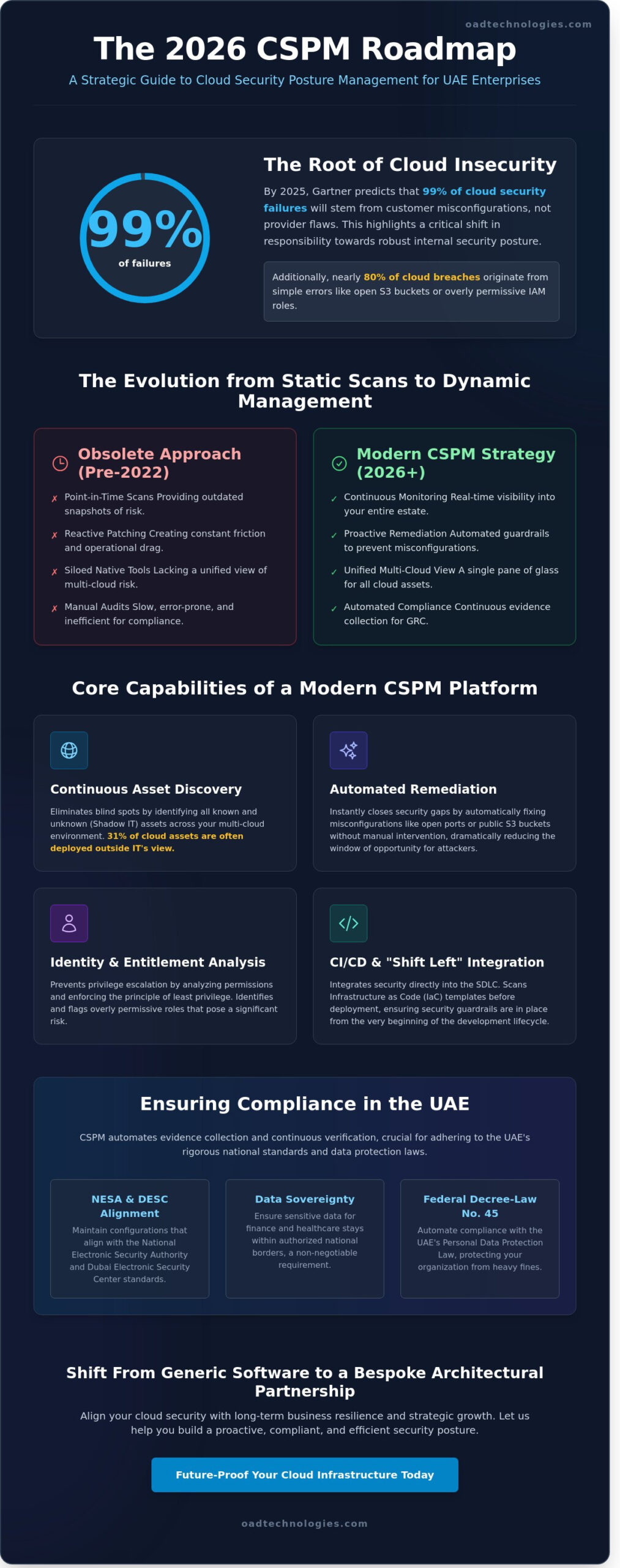
By 2025, Gartner predicts that 99% of cloud security failures will stem from customer misconfigurations rather than provider flaws. For organizations in the UAE, where the digital economy is projected to contribute 20% to the non-oil GDP by 2031, the stakes for maintaining a robust cloud security posture management cspm strategy have never been higher. You’re likely already struggling with the noise of alert fatigue and the visibility gaps that emerge when Shadow IT bypasses your governance. It’s a common challenge to align rapid innovation with the strict requirements of local frameworks like the NESA IAS or DESC standards.
We understand that a one-size-fits-all security approach fails in a complex multi-cloud reality. This guide provides a strategic roadmap to help you achieve automated remediation and a unified view of your entire digital estate. You’ll learn how to transform your security from a reactive hurdle into a proactive asset that ensures continuous compliance and operational efficiency. We’ll examine the technical architecture and strategic shifts necessary to future-proof your infrastructure for 2026 and beyond.
Key Takeaways
- Navigate the “Complexity Tax” of the 2026 multi-cloud landscape by evolving from simple visibility to continuous, proactive environment monitoring.
- Identify and eliminate security gaps instantly through automated remediation and the discovery of both known and shadow cloud assets.
- Clarify the technical distinctions between cloud security posture management cspm, CWPP, and CNAPP to build a high-ROI security stack tailored for the UAE market.
- Implement a structured roadmap to establish security baselines and apply global standards like NIST or CIS Benchmarks without operational friction.
- Shift from generic software deployment to a bespoke architectural partnership that aligns your cloud security with long-term business resilience and strategic growth.
The 2026 Cloud Landscape: Why Visibility is No Longer Enough
The cloud environment in 2026 functions as a living, breathing ecosystem rather than a static repository. Cloud security posture management cspm has evolved into the essential automated watchdog for this architecture; it provides continuous monitoring across IaaS, PaaS, and SaaS layers to identify and remediate misconfigurations. Organizations in the UAE now face a “Complexity Tax” as they manage intricate multi-cloud and hybrid environments. While native tools from providers like AWS or Azure offer basic oversight, they often operate in silos. This fragmentation prevents a unified view of risk, leaving gaps that attackers quickly exploit. Data from 2024 indicates that nearly 80% of cloud breaches originate from simple misconfigurations, such as open S3 buckets or overly permissive IAM roles. Relying on disconnected native tools is no longer a viable strategy for the modern enterprise.
The Evolution from Static Scanning to Dynamic Posture Management
Security protocols from the 2020 era relied heavily on point-in-time scans that provided a snapshot of vulnerabilities. In 2026, these static methods are obsolete. Modern cloud security posture management cspm requires real-time monitoring to keep pace with rapid deployment cycles. OAD Technologies advocates for a shift toward proactive risk visualization and sophisticated threat modeling. This approach integrates security directly into the software development lifecycle (SDLC), ensuring that guardrails exist before code ever reaches production. By moving from reactive patching to proactive posture management, businesses reduce their attack surface while empowering development teams to innovate without friction.
The Critical Role of CSPM in National Compliance
Compliance in the UAE has become increasingly rigorous with the enforcement of Federal Decree-Law No. 45 of 2021 regarding the Protection of Personal Data. CSPM platforms automate the grueling process of evidence collection for governance risk and compliance, replacing manual audits with continuous verification. For industries like finance and healthcare in Dubai and Abu Dhabi, maintaining national data sovereignty is a non-negotiable requirement. CSPM ensures that data stays within authorized borders and that configurations align with NESA standards. This level of continuous audit readiness protects the organization from heavy fines and preserves the trust of a sophisticated digital clientele. We don’t just secure data; we build a resilient framework for long-term operational integrity.
Core Capabilities of Modern Cloud Security Posture Management
Modern cloud security posture management cspm goes beyond simple compliance checklists. It functions as a living blueprint of your digital estate. Organizations in the UAE, particularly those aligning with NESA or Dubai Electronic Security Center (DESC) standards, require real-time visibility that captures every spinning instance. Shadow IT remains a persistent threat. Industry data shows that 31% of cloud assets are often deployed outside the view of central IT teams. A robust CSPM solution identifies these unknown assets instantly, ensuring no resource remains unprotected.
Effective security requires more than just visibility. These platforms deliver several critical functions:
- Continuous Discovery: Identifying known and unknown assets to eliminate blind spots across multi-cloud environments.
- Automated Remediation: Closing security gaps instantly by fixing misconfigured S3 buckets or open ports without manual intervention.
- Identity and Entitlement Analysis: Analyzing permissions to prevent privilege escalation and ensure the principle of least privilege.
- CI/CD Integration: Shifting security left by scanning Infrastructure as Code (IaC) templates before they reach production.
By embedding these capabilities into the development lifecycle, businesses achieve a state of continuous compliance. This proactive stance reduces the window of opportunity for attackers. OAD Technologies helps enterprises implement bespoke security frameworks that align these technical controls with specific business growth targets.
Beyond the Dashboard: Risk Contextualization
Alert fatigue often cripples security teams. A “Critical” alert on a siloed test server doesn’t demand the same urgency as a minor flaw on a production database holding sensitive customer records. Modern CSPM platforms use graph-based technology to map complex attack paths, identifying how a single misconfiguration could lead to a massive data breach. Contextualized Risk is the intersection of vulnerability, exploitability, and business impact. This logical mapping allows teams to prioritize high-stakes issues that actually threaten operational continuity.
Automated vs. Manual Remediation
Guardrails serve as the first line of defense. They prevent misconfigurations from happening by enforcing policy-as-code during the deployment phase. While full automation offers unmatched speed, it carries risks if applied to complex, legacy environments. Certain high-level architectural changes require the oversight of an Expert Architect to ensure that a fix doesn’t inadvertently break a critical workflow or impact scalability. Standardized Playbooks bridge this gap. They provide a clear, repeatable roadmap for incident response that combines machine speed with human precision, ensuring that every action taken is both accurate and documented.
CSPM vs. CWPP vs. CNAPP: Building the Right Security Stack
CISOs across the UAE face a complex alphabet soup of acronyms that often obscure the path to a resilient infrastructure. Choosing between CSPM, CWPP, and CNAPP isn’t just about technical features; it’s about strategic alignment with your digital maturity. Cloud security posture management cspm operates at the control plane level. It audits the APIs and configurations of your cloud provider to ensure you haven’t left a storage bucket open or misconfigured a virtual network. By contrast, Cloud Workload Protection Platforms (CWPP) dive inside the instance. They protect the actual operating systems and applications running within your containers or VMs.
The industry shift toward Cloud-Native Application Protection Platforms (CNAPP) reflects a 45 percent increase in demand for consolidated security stacks since 2023. CNAPP integrates CSPM and CWPP into a single pane of glass, reducing the alert fatigue that plagues security teams in Dubai and Abu Dhabi. For organizations starting their cloud journey, prioritizing cloud security posture management cspm provides the highest ROI. It addresses the 99 percent of cloud breaches that analysts predict will be the customer’s fault through 2025. As workloads scale, adding CWPP becomes essential for runtime threat detection.
- CSPM: Best for compliance, visibility, and preventing misconfigurations at the infrastructure level.
- CWPP: Essential for protecting specific workloads, including serverless functions and Kubernetes clusters.
- CNAPP: The target state for mature enterprises seeking a unified view of the entire application lifecycle.
The Synergy Between CSPM and Managed Detection
Effective security doesn’t exist in a vacuum. CSPM data acts as a critical force multiplier for managed detection and response telemetry. When your SOC receives an alert, posture data provides the context needed to determine if a vulnerability is reachable from the public internet. This visibility transforms a reactive team into a proactive unit, allowing for the prioritization of risks based on actual business impact rather than generic severity scores. A unified view across endpoints and cloud assets ensures that no blind spots remain in your defensive architecture.
Integrating Identity into Posture Management
In the modern cloud environment, identity is the new perimeter. Integrating CSPM with a robust identity and access management framework is non-negotiable for comprehensive protection. Most cloud breaches involve the exploitation of over-privileged accounts. By applying the principle of least privilege, organizations can ensure that even if a credential is compromised, the blast radius is limited. Posture management tools now analyze IAM roles to identify “shadow” permissions, ensuring your UAE-based operations remain compliant with local NESA and IA standards while maintaining peak operational efficiency.
Strategic Implementation: Overcoming Alert Fatigue and Operational Friction
Executing a successful cloud security posture management cspm strategy requires moving beyond simple tool deployment. It demands a structured lifecycle that aligns technical controls with business objectives. Organizations in the UAE, particularly those navigating the stringent requirements of NESA or the Dubai Electronic Security Center (DESC), must treat implementation as an architectural project rather than a software installation.
The transition to a proactive security stance follows five critical stages:
- Step 1: Discovery and Baselining. You cannot secure what you haven’t identified. We begin by cataloging every resource across multi-cloud environments to establish a comprehensive inventory.
- Step 2: Policy Standardization. We apply frameworks such as CIS Benchmarks or NIST SP 800-53. These provide a globally recognized foundation for configuration integrity.
- Step 3: Context-Aware Prioritization. We move away from relying solely on CVSS scores. Instead, we weigh risks against business impact. A minor misconfiguration on a production server in Dubai carries more weight than a critical error in a sandbox environment.
- Step 4: Workflow Integration. Security must exist where the work happens. We integrate CSPM outputs directly into existing ITSM tools like Jira or ServiceNow.
- Step 5: Continuous Optimization. Security policies aren’t static. We regularly review and adjust thresholds to ensure the system evolves alongside your infrastructure.
Solving the Alert Fatigue Crisis
The psychological toll of “noise” is measurable. A 2023 industry study found that 55% of security teams receive over 10,000 alerts per day, leading to burnout and missed threats. OAD Technologies addresses this by implementing intelligent threshold tuning and alert grouping. By correlating related events into a single incident, we help our clients filter out 90% of non-critical noise. This precision ensures your team focuses on the 10% of alerts that actually represent a breach path.
Fostering a DevSecOps Culture
Operational friction occurs when security becomes a bottleneck for innovation. We bridge this gap by providing developers with “In-App” guidance. Instead of a vague ticket, engineers receive specific remediation scripts and the technical “why” behind a policy. This transparency builds trust. When security provides actionable data without slowing down the CI/CD pipeline, it transforms from a gatekeeper into an enabler. This collaborative approach is essential for UAE enterprises aiming for rapid digital transformation while maintaining sovereign data integrity.
Ready to transform your security operations from a cost center into a strategic advantage? Partner with OAD Technologies to build a resilient, automated cloud defense system today.
The OAD Approach: Bespoke Cloud Security Posture Management
OAD Technologies operates as an Expert Architect for your organization’s cloud journey. We move beyond the limitations of generic software deployments, which often leave critical gaps in complex environments. Our team facilitates a transition from basic tool implementation to a tailored strategic partnership. This ensures that your security framework aligns perfectly with your specific operational requirements and risk appetite. In the United Arab Emirates, where the cost of a data breach averaged AED 29.6 million in 2023, a standard configuration is no longer sufficient to protect high-value digital assets.
We integrate cloud security posture management cspm into our broader technical assessment services. This holistic methodology allows us to identify misconfigurations that automated tools might overlook. Our engineers analyze your architecture to ensure compliance with local regulations like the NESA UAE Information Assurance Standards. A mature cloud security posture provides a clear ROI by fostering resilience and enabling faster strategic growth. When security is built into the foundation, scaling your digital operations becomes a seamless process rather than a risk-laden hurdle.
- Elimination of security silos through integrated technical assessments.
- Direct alignment with UAE regulatory frameworks and data residency laws.
- Customized remediation workflows that reduce operational downtime.
- Enhanced visibility across complex, hybrid cloud architectures.
Future-Proofing Your Cloud Infrastructure
The role of AI in posture management will shift by 2026, moving from simple detection to predictive autonomous remediation. OAD Technologies is already preparing for this shift by developing frameworks that stay ahead of evolving threat vectors. We focus on maintaining your long-term digital relevance in a multi-cloud world. Our strategy ensures your infrastructure remains robust against sophisticated attacks while supporting the rapid adoption of emerging technologies. We don’t just solve today’s problems; we build the defenses you’ll need for tomorrow’s challenges.
Next Steps: Securing Your Digital Transformation
Your journey toward a resilient cloud environment starts with a deep dive into your current setup. We invite you to schedule a technical posture assessment with our senior architects. This process provides a clear, actionable path toward a bespoke cloud security posture management strategy designed for your unique business needs. Don’t leave your infrastructure to chance. Contact OAD Technologies today for a tailored cloud security consultation and take control of your digital future.
Architecting Resilience for the 2026 Cloud Landscape
The rapid evolution of digital infrastructure means that visibility alone won’t protect your assets as we approach 2026. Success requires a transition from reactive patching to proactive, automated governance. Organizations across the UAE must now harmonize their security stacks to meet rigorous local compliance standards and data sovereignty laws. Implementing a robust cloud security posture management cspm strategy is the most effective way to eliminate alert fatigue while ensuring your multi-cloud environment remains audit-ready. It’s about moving beyond basic checklists to a state of continuous, intelligent oversight.
OAD Technologies bridges the gap between complex technical requirements and practical business results. We provide bespoke technical assessments tailored for the UAE market, focusing on the seamless integration of security into your current GRC and MDR frameworks. Our team acts as an extension of your own; we specialize in solving the intricate challenges of hybrid environments without the friction of one-size-fits-all tools. You’ll gain a clear roadmap for long-term digital relevance and operational efficiency. It’s time to transform your security posture into a strategic advantage.
Secure your cloud future with a bespoke CSPM strategy from OAD Technologies.
Let’s build a secure foundation for your next decade of innovation.
Frequently Asked Questions
What is the primary difference between CSPM and a standard vulnerability scanner?
CSPM monitors the cloud control plane and infrastructure configurations, whereas standard vulnerability scanners focus on software flaws within virtual machines or containers. While a scanner identifies a missing patch in an operating system, CSPM detects an unencrypted storage bucket or an overly permissive identity role. This distinction is vital because Gartner reports that 99% of cloud security failures through 2025 will result from customer misconfigurations rather than provider flaws.
Can CSPM tools fix misconfigurations automatically without human intervention?
CSPM tools fix misconfigurations automatically through a process called automated remediation. You can configure specific policies to trigger instant corrections, such as closing a network port that was accidentally opened to the public. OAD Technologies recommends a tiered approach where 70% of low-risk issues are automated. High-impact changes still require human approval to ensure that security fixes don’t disrupt your operational uptime.
How does CSPM help with regulatory compliance like the UAE Personal Data Protection Law?
CSPM helps you comply with the UAE Personal Data Protection Law (Federal Decree-Law No. 45 of 2021) by mapping cloud configurations to specific data sovereignty and security requirements. It provides real-time reporting on where your data resides and who can access it. By automating these audits, UAE businesses reduce the time spent on compliance documentation by 40%, ensuring that personal data stays within the legal frameworks mandated by the government.
Do I need a CSPM if I only use one cloud provider like AWS or Azure?
You need a dedicated cloud security posture management cspm solution even if you only use one provider like AWS or Azure. Native tools provide basic checks, but they often lack the deep contextual analysis and unified dashboard required for complex environments. Research shows that 80% of organizations use more than one cloud service eventually. A centralized CSPM ensures you maintain a consistent security baseline as your infrastructure scales and evolves.
How does CSPM integrate with my existing SIEM or EDR solutions?
CSPM integrates with your SIEM or EDR solutions through standard APIs and webhooks to provide a unified view of your security state. It feeds configuration alerts into your SIEM, such as Splunk or IBM QRadar, allowing your SOC team to correlate misconfigurations with active threat data. This integration reduces the mean time to respond (MTTR) by providing the architectural context that endpoint-focused EDR tools often miss.
What are the most common cloud misconfigurations that CSPM detects?
The most common misconfigurations detected include publicly accessible storage buckets, unrestricted outbound traffic, and inactive multi-factor authentication for root accounts. According to the 2023 Cloud Security Report, 27% of organizations experienced a security incident due to misconfigured cloud resources. CSPM identifies these gaps instantly, preventing data leaks that could lead to significant fines under UAE cybersecurity regulations.
Is CSPM suitable for small businesses, or is it strictly an enterprise solution?
CSPM is essential for small businesses because cloud complexity affects every organization regardless of its size. Smaller teams often lack dedicated security personnel, making the automated oversight of a cloud security posture management cspm platform a vital force multiplier. Since a single data breach can cost a UAE business an average of 25,000,000 AED according to industry benchmarks, the proactive protection of CSPM is a strategic investment for any growth-oriented company.
How long does it typically take to see ROI from a CSPM implementation?
You’ll see technical ROI immediately through the discovery of existing risks, while financial ROI typically materializes within 3 to 6 months. This return comes from reducing manual audit hours by 50% and avoiding the costs associated with data breaches or regulatory non-compliance. By automating 24/7 monitoring, your team can focus on digital transformation projects that drive revenue instead of chasing manual configuration errors.
Disclaimer
Content by OAD Technologies is for general informational purposes only and does not constitute professional or cybersecurity advice. No warranties are made regarding accuracy or completeness; reliance is at your own risk. OAD Technologies shall not be liable for any direct or indirect losses arising from use of this content.