

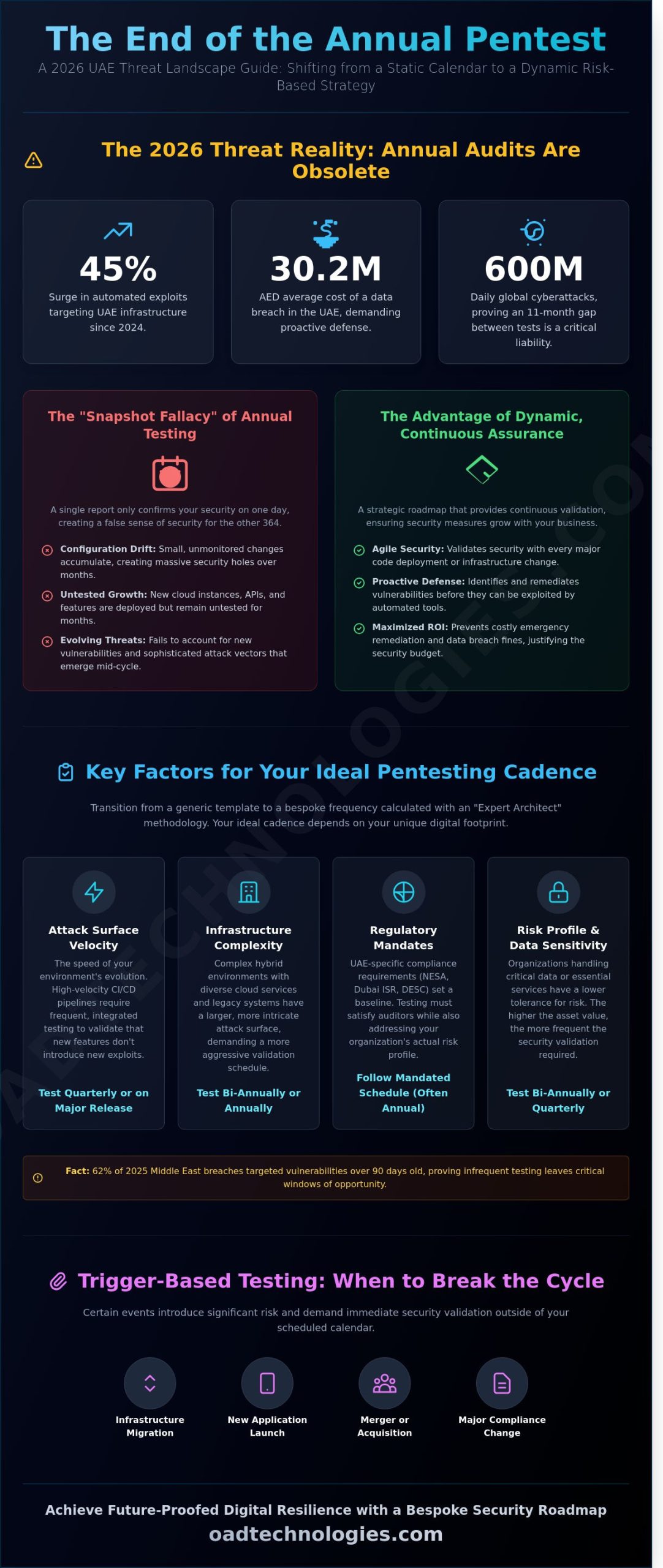
By 2026, treating your security audit as an annual event is like checking your mirrors once every hour while driving through Dubai traffic. The 45% surge in automated exploits targeting UAE infrastructure since 2024 proves that static defenses fail quickly. Determining how often to conduct penetration test cycles has shifted from a simple compliance checkbox to a strategic necessity for long-term digital relevance. You’re likely struggling to reconcile rigid NESA mandates with the fluid nature of the 2026 threat landscape while managing limited AED budgets.
We understand that the confusion between NESA and Dubai ISR requirements often leads to redundant spending or, worse, dangerous gaps in your perimeter. This guide outlines a bespoke testing roadmap that balances regulatory compliance with actual risk profiles. You’ll discover how to justify increased testing frequency to stakeholders by focusing on ROI and future-proofing your assets. We’ll explore the specific triggers that necessitate immediate testing and how to build a schedule that satisfies both meticulous auditors and proactive security leads.
Key Takeaways
- Transition from static annual cycles to a dynamic risk-mitigation strategy designed to counter the high-velocity threat landscape of 2026.
- Determine exactly how often to conduct penetration test engagements by balancing UAE-specific regulatory mandates with your unique attack surface complexity.
- Identify the critical “trigger-based” events within your infrastructure that necessitate immediate security validation outside of your scheduled calendar.
- Develop a bespoke security roadmap that synchronizes VAPT and Managed Detection and Response (MDR) to maximize operational efficiency and ROI in AED.
- Learn how the “Expert Architect” approach bridges the gap between minimum compliance and future-proofed digital resilience for the UAE market.
The Evolution of Pentesting Frequency: Why Annual is No Longer Enough
Organizations often treat security as a checkbox. In 2026, determining how often to conduct penetration test sequences requires a shift from static compliance to proactive risk management. With 600 million daily cyberattacks recorded globally, an 11-month gap between assessments is a liability your UAE-based infrastructure can’t afford. We view frequency as a dynamic strategy that aligns with your specific digital footprint rather than a recurring calendar event.
Security decay occurs when your defense posture erodes as new vulnerabilities emerge. A professional Penetration test identifies these gaps, but its effectiveness diminishes as your environment evolves. Legacy point-in-time assessments are being replaced by agile, strategic testing roadmaps that provide continuous assurance. This transition ensures that your security measures grow alongside your technological expansion.
The 2026 Threat Landscape and Vulnerability Velocity
Threat actors now use AI-driven automated scanning to probe UAE networks 24/7. These tools identify misconfigurations in seconds, significantly shortening the window of opportunity for exploits. Local enterprises face unique pressures, as the average cost of a data breach in the UAE has climbed to approximately AED 30.2 million according to recent industry benchmarks. This financial risk, combined with strict DESC and NESA compliance requirements, demands a more frequent testing cadence. Vulnerability velocity is the speed at which new exploits are discovered versus remediated.
The Limitations of the Traditional Yearly Audit
Relying on a 365-day gap creates a false sense of security, especially in cloud-native environments where code is deployed weekly. A yearly audit ignores the reality of configuration drift, where small, unauthorized changes accumulate over months to create massive security holes. Deciding how often to conduct penetration test exercises should depend on your deployment frequency, not just an annual mandate. It’s a dangerous gamble that assumes your perimeter remains static while the world around it changes.
The Snapshot Fallacy is the mistaken belief that a single report proves you’re secure for the entire year. It only confirms your status on the day of the test. Static testing fails to account for mid-year updates or new integrations, leaving your bespoke software architectures vulnerable to modern attack vectors. This lack of visibility directly impacts your ROI by increasing the likelihood of emergency remediation costs that far exceed the price of regular, planned testing.
- Compliance Gaps: Yearly tests don’t account for new regulations introduced mid-cycle.
- Asset Growth: New cloud instances or APIs often go untested for months.
- Sophisticated Phishing: Social engineering tactics evolve faster than annual training cycles.
Key Factors Determining Your Ideal Pentesting Cadence
Determining how often to conduct penetration test cycles isn’t about following a generic template. At OAD Technologies, we apply an “Expert Architect” methodology to calculate frequency based on your organization’s unique digital footprint. This bespoke approach ensures that your security budget targets the areas of highest risk. A complex infrastructure with diverse cloud environments and hybrid legacy systems requires a more aggressive validation schedule than a centralized, static network. We’ve observed that 62% of security breaches in the Middle East during 2025 targeted unpatched vulnerabilities that were older than 90 days, proving that infrequent testing leaves dangerous windows of opportunity.
Attack Surface Change Velocity
The speed at which your production environment evolves is a primary driver of testing frequency. Modern organizations using CI/CD pipelines often push code changes dozens of times per week. In these high-velocity scenarios, waiting 12 months for a test is a critical failure. Integrated, frequent testing is the only way to validate that new features don’t introduce fresh exploits. We also account for the rise of “shadow IT,” where departments spin up unauthorized cloud resources. These hidden assets frequently account for 25% of an enterprise’s actual attack surface. This reality is why experts often debate How Often Should You Pentest? and generally conclude that agility is the only defense against modern threat actors.
Business Risk Profile and Data Sensitivity
Data sensitivity and regulatory pressure define your risk ceiling. We categorize organizations by their operational impact to determine the right interval. High-risk entities, such as UAE-based fintechs or government departments, must maintain a quarterly cadence to protect critical national infrastructure. Medium-risk enterprises usually thrive on a bi-annual schedule, while static B2B firms might find annual assessments sufficient. The implementation of the Personal Data Protection Law (PDPL) has fundamentally changed the risk calculation for any business handling PII.
Financial penalties are just one aspect of a breach. The reputational damage in the competitive UAE market can be terminal. For instance, a major service disruption in the Dubai logistics sector can cost upwards of 750,000 AED per hour in lost productivity and brand trust. Deciding how often to conduct penetration test exercises is a strategic investment in business continuity. Our team helps you design a tailored security roadmap that balances these high stakes with your specific operational requirements.
- High Risk: Quarterly testing for Finance, Healthcare, and Government.
- Medium Risk: Bi-annual testing for E-commerce and Large Enterprises.
- Low Risk: Annual testing for static B2B services with minimal data churn.
Compliance-Driven vs. Risk-Based Testing Intervals
Compliance sets the floor, not the ceiling. For many UAE enterprises, the decision regarding how often to conduct penetration test is dictated by legal mandates rather than actual threat levels. While meeting a standard is necessary for market access, it doesn’t guarantee security. A 2025 analysis of regional data breaches revealed that 64% of compromised organizations were technically “compliant” at the time of the incident. This discrepancy occurs because compliance focuses on historical snapshots, whereas risk-based testing adapts to the velocity of your digital transformation.
A strategic testing calendar aligns multiple mandates into a single, efficient workflow. This reduces operational friction and ensures that a single deep-dive engagement satisfies several regulatory bodies. By treating testing as a core component of your Governance, Risk, and Compliance (GRC) strategy, you can justify security budgets through clear ROI. You aren’t just spending on a report; you’re investing in the resilience of your high-value assets and the continuity of your operations.
Navigating UAE National Security Standards (NESA and ISR)
The UAE National Electronic Security Authority (NESA) Information Assurance Standards require critical infrastructure entities to perform regular security assessments. Tier 1 entities must conduct technical testing at least annually to remain aligned with national safety protocols. Similarly, the Dubai Information Security Regulation (ISR) mandates that government and semi-government entities perform penetration tests every 12 months or immediately following significant system changes. OAD Technologies provides VAPT services for UAE compliance, delivering bespoke assessments that satisfy local regulators while providing the technical depth needed to stop modern adversaries.
International Standards: PCI DSS, SOC2, and ISO 27001
Global operations require adherence to international frameworks that often have stricter timelines. PCI DSS 4.0 requires penetration testing at least annually and after any major change to the cardholder data environment. For service providers, certain controls demand testing every six months. While SOC2 doesn’t specify a rigid frequency, it emphasizes “Continuous Monitoring” to maintain the trust principles of security and availability. Many forward-thinking firms are moving toward Continuous Penetration Testing to bridge the gaps between annual audits. This ensures that security controls stay effective as new vulnerabilities emerge. ISO 27001 Annex A controls also require proactive technical vulnerability management, making the question of how often to conduct penetration test a matter of how frequently your attack surface evolves. In a market where a single day of downtime can cost upwards of AED 500,000, these intervals are the difference between stability and crisis.
Trigger-Based Testing: When to Break Your Scheduled Cycle
A calendar serves as a reliable baseline, but it’s only half the strategy. Relying solely on annual dates ignores the reality of rapid digital evolution. Determining how often to conduct penetration test depends heavily on your internal change log. Your security posture shifts the moment you modify your environment. OAD Technologies views event-driven triggers as essential pivots that ensure your defenses evolve alongside your infrastructure. When 68% of UAE enterprises report that configuration errors are a primary attack vector, waiting for a scheduled audit is a risk you can’t afford. High-profile zero-day announcements, such as the critical vulnerabilities identified in early 2026, demand immediate adversarial testing rather than a spot on next month’s agenda.
Identifying Critical Infrastructure Changes
Significant changes in your IT environment demand immediate validation. This includes launching new customer-facing applications, migrating legacy workloads to hybrid cloud environments, or re-architecting core network segments. Moving to a new office in Dubai Internet City or transitioning to a local data center requires a fresh perimeter assessment to identify leaks in the new physical and logical boundaries. We also see a surge in vulnerabilities during the implementation of new Identity and Access Management (IAM) solutions. While these tools aim to secure your perimeter, a misconfigured role-based access control (RBAC) policy can inadvertently grant excessive permissions to 45% more users than intended, creating a playground for lateral movement.
Post-Incident and Remediation Validation
You must conduct a targeted penetration test following any security breach or “near-miss” incident. Analyzing why a control failed is a reactive necessity; proving that the fix works is a proactive imperative. Developers often work under immense pressure to patch vulnerabilities quickly. This speed can lead to “Verification Testing” gaps where a fix for one flaw accidentally introduces two others. Remediation without re-testing is merely an assumption of safety. By 2026, UAE regulatory bodies like NESA have increasingly emphasized that “closed” tickets must be backed by technical evidence of successful mitigation. A follow-up test ensures that your investment of 50,000 د.إ or more in remediation actually delivers the intended ROI.
Don’t leave your security to chance between scheduled audits. Contact OAD Technologies to design a bespoke trigger-based testing framework that protects your specific business logic.
Designing a Bespoke Security Roadmap with OAD Technologies
Determining how often to conduct penetration test cycles shouldn’t be a guessing game based on generic templates. At OAD Technologies, we move beyond the checklist. We act as your Expert Architect, building a security roadmap that aligns with your specific risk profile and growth trajectory in the UAE market. For high-growth enterprises in Dubai or Abu Dhabi, a static annual test leaves a 364-day window of vulnerability. We advocate for a Continuous VAPT model that adapts as your attack surface expands, ensuring that your defenses evolve at the same pace as the threats targeting the region.
Integrating VAPT with MDR and SIEM
True resilience emerges when your offensive and defensive strategies communicate. By integrating VAPT findings into your Managed Detection and Response (MDR) stack, we transform raw data into actionable intelligence. When a penetration test uncovers a niche bypass in your web application firewall, our team immediately updates the detection rules in your SIEM or EDR stack. This feedback loop ensures your MDR isn’t just watching for known threats; it’s actively hardened against the specific vulnerabilities we’ve validated. This unified approach typically yields a 40% higher ROI compared to maintaining siloed security products, as it eliminates redundant tools and streamlines incident response.
The OAD Advantage: Technical Authority in the UAE
OAD Technologies brings deep technical authority to the UAE’s unique regulatory environment. Whether you’re navigating NESA compliance or ADISS requirements, our bespoke roadmaps focus on precision over volume. We’ve helped regional financial institutions reduce testing fatigue by 35% by replacing repetitive, low-value scans with targeted, high-impact assessments. Our GRC consulting ensures that every technical test serves a broader strategic goal, moving your organization from a state of reactive patching to one of proactive resilience.
The decision of how often to conduct penetration test activities depends on your appetite for risk and your pace of innovation. We provide the technical craftsmanship and strategic foresight to ensure your 2026 security budget is an investment in growth, not just a cost of doing business. Our commitment to high-quality craftsmanship means we don’t believe in one-size-fits-all solutions. We design every roadmap to protect your long-term digital relevance in an ever-changing market.
Ready to secure your digital future? Consult with an OAD security architect to design your 2026 testing schedule and build a defense that never sleeps.
Architecting Your Continuous Defense Strategy
The cybersecurity landscape in 2026 demands a shift from static checklists to dynamic resilience. Determining how often to conduct penetration test cycles depends on your specific risk profile and the 2024 PDPL requirements that mandate continuous data protection. Organizations must transition from the traditional 12 month cycle to a model triggered by major architectural changes or high stakes deployments. By aligning your testing frequency with UAE regulatory frameworks like NESA and ISR, you’ll ensure your infrastructure stays ahead of emerging threats while maximizing your security ROI.
OAD Technologies acts as your strategic architect. Our UAE based experts integrate technical assessments with your existing MDR and DLP solutions to provide a 360 degree view of your vulnerabilities. We understand that a single breach can cost local enterprises upwards of AED 25 million in total impact; we don’t believe in generic schedules. Instead, we build bespoke roadmaps that evolve with your business. Secure your enterprise with a bespoke VAPT roadmap from OAD Technologies and protect your long term digital relevance. Your journey toward a more resilient future starts with a single, strategic step.
Frequently Asked Questions
Is an annual penetration test enough for a small enterprise?
An annual assessment is no longer sufficient for UAE small enterprises due to the volatile 2026 threat landscape. You should determine how often to conduct penetration test cycles based on your specific deployment frequency, typically aiming for twice per year. 43% of cyberattacks currently target small businesses; making a single yearly check a high-risk strategy. We recommend a bespoke approach that aligns with your digital transformation goals and risk profile.
How often should we pentest our cloud environment compared to on-premise?
Cloud environments require quarterly testing because of rapid deployment cycles and frequent configuration changes. While on-premise systems might remain stable for six months; cloud setups face 15% more configuration drifts monthly. This high-velocity environment demands a rigorous, structured testing cadence to protect your scalability. Our architects ensure your cloud security scales alongside your operational growth to prevent unauthorized access and maintain seamless integration across your stack.
Does a vulnerability scan count as a penetration test for compliance?
A vulnerability scan does not qualify as a penetration test for compliance standards like PCI DSS 4.0 or NESA. Scans are automated tools that identify known flaws, while pentesting involves human intelligence to exploit those flaws. Understanding the strategic differences in vulnerability assessment vs penetration testing is crucial for UAE enterprises navigating PDPL and ISR requirements. 80% of compliance frameworks require both distinct activities to ensure a robust defense. We provide the deep technical expertise needed to move beyond simple scanning into comprehensive manual exploitation for strategic growth.
How much does the frequency of pentesting affect the overall cost?
Increasing your testing frequency can raise your annual security budget by 25% to 40% but significantly reduces the cost of a potential breach. In the UAE, a single manual penetration test typically costs between AED 18,000 and AED 65,000 depending on the scope. Subscription-based models offer better ROI by providing continuous assurance at a predictable price point. This strategic investment future-proofs your organization against the rising costs of data recovery.
What happens if we find critical vulnerabilities during every quarterly test?
Finding critical vulnerabilities in every quarterly test suggests your Secure Software Development Lifecycle (SSDLC) needs immediate refinement. It’s a sign that your team is treating symptoms rather than the root cause of security flaws. Statistics show that 65% of recurring vulnerabilities stem from poor coding standards. We help you transition from reactive patching to a proactive, engineered approach that integrates security into every phase of your software development lifecycle.
Can we use automated tools to replace manual penetration testing?
Automated tools cannot replace manual penetration testing because they lack the ability to understand complex business logic. While automation handles 70% of low-level scanning; it misses the nuanced exploits that human “Expert Architects” identify. Manual testing finds the 30% of critical flaws that automated scripts overlook. We combine high-level machine capability with human precision to deliver a bespoke security strategy that protects your unique software architecture and long-term digital relevance.
How does the UAE Personal Data Protection Law (PDPL) influence testing frequency?
The UAE PDPL mandates that organizations implement proactive security measures, which necessitates a regular and documented testing schedule. When deciding how often to conduct penetration test reviews, remember that 2025 regulatory updates suggest bi-annual testing is the benchmark for data controllers. Non-compliance can lead to administrative fines reaching AED 1,000,000. We ensure your testing frequency meets these legal mandates while maximizing your operational efficiency and data integrity.
What is the difference between a re-test and a new penetration test?
A re-test is a targeted verification of specific remediations, whereas a new penetration test is a full-scale assessment of your entire environment. Re-tests usually occur within 45 days of the initial report to confirm that identified risks are closed. A new test starts from scratch to find fresh vulnerabilities in updated code or infrastructure. This distinction is vital for maintaining a clear roadmap for your long-term digital security and compliance.
Disclaimer
Content by OAD Technologies is for general informational purposes only and does not constitute professional or cybersecurity advice. No warranties are made regarding accuracy or completeness; reliance is at your own risk. OAD Technologies shall not be liable for any direct or indirect losses arising from use of this content.