

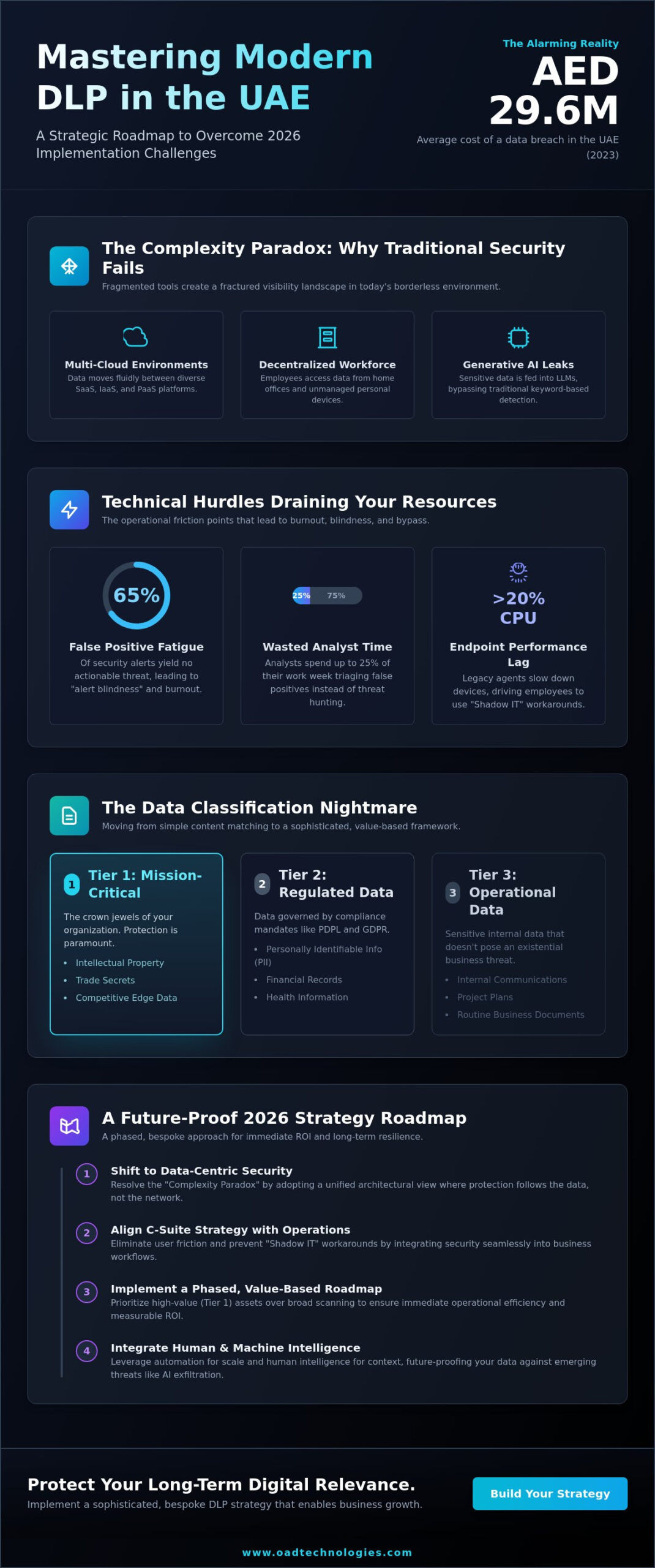
Did you know that the average cost of a data breach in the UAE reached a record AED 29.6 million in 2023? This staggering figure proves that while digital transformation accelerates in the Emirates, traditional security often lags behind. You’ve probably noticed that your security team is drowning in a sea of false positives while your employees find creative ways to bypass restrictive policies. It’s a common frustration to face dlp implementation challenges where 65% of security alerts yield no actionable threat, especially when managing fragmented data across diverse multi-cloud environments.
We’re here to show you that mastering these hurdles doesn’t have to mean sacrificing user experience or operational agility. This article provides a sophisticated roadmap to help you build a future-proof 2026 strategy that prioritizes both visibility and seamless integration. You’ll discover a structured framework designed to reduce alert fatigue and secure your most valuable digital assets through a bespoke, architected approach that balances technical rigor with business growth.
Key Takeaways
- Navigate the shift toward data-centric security in the UAE’s borderless digital environment by resolving the “Complexity Paradox” of modern toolsets.
- Learn to mitigate critical dlp implementation challenges, from reducing false positive fatigue to accurately classifying unstructured data at scale.
- Align C-suite strategy with operational reality to eliminate user friction and prevent the “workarounds” that compromise organizational security.
- Implement a phased, bespoke roadmap that prioritizes high-value assets over broad scanning to ensure immediate operational efficiency and ROI.
- Discover how the intersection of human intelligence and automated infrastructure can future-proof your data and protect your long-term digital relevance.
Why Modern DLP Implementation Challenges Exist in 2026
The traditional security perimeter vanished years ago. Today’s enterprise data lives in a borderless environment, moving between cloud SaaS, local endpoints, and remote home offices across the UAE. This shift forces a transition to data-centric security, where protection follows the data itself rather than the network. However, many organizations face a complexity paradox. By deploying fragmented tools to cover every new gap, they’ve created a fractured visibility landscape that obscures critical risks. Modern dlp implementation challenges stem from this lack of a unified architectural view. Legacy DLP systems, built for a pre-AI era, fail to recognize the nuanced ways data leaks in 2026, especially through generative AI prompts and unstructured collaboration channels. Balancing seamless data accessibility with rigorous security protocols remains the central friction point for IT leaders.
The Impact of AI and Decentralized Workforces
Generative AI and Large Language Models (LLMs) have introduced shadow AI risks that traditional filters cannot catch. Employees often feed sensitive corporate data into public models to automate tasks, creating unstructured leak vectors that bypass standard regex-based detection. In the UAE’s remote-first corporate culture, monitoring data on unmanaged personal devices adds another layer of difficulty. AI data exfiltration stands as the top emerging risk of 2026. Security teams must now govern not just where data goes, but how AI consumes it. Effective strategies require bespoke controls that understand context rather than just keywords.
Regulatory Evolution and Compliance Pressure
The UAE’s Personal Data Protection Law (PDPL) and international mandates like GDPR have increased the stakes for data mishandling. Meeting these standards is a baseline, but many firms fall into the “Compliance vs. Security” trap by checking boxes while leaving actual vulnerabilities exposed. Strategic leaders must align their technical controls with a broader governance, risk, and compliance (GRC) framework to ensure long-term resilience. Relying solely on compliance audits often leads to a false sense of safety that evaporates during a real breach. Solving dlp implementation challenges requires an integrated approach that treats security as a business enabler, not just a regulatory hurdle. This alignment ensures that every byte of data is accounted for without stifling the operational speed that Dubai’s competitive market demands.
Technical Hurdles: From False Positives to Data Classification
Organizations in the UAE often find that the most persistent dlp implementation challenges aren’t financial; they’re technical. In 2024, security analysts reported spending up to 25% of their work week triaging false positives. This “False Positive Fatigue” triggers a dangerous cycle of burnout. When a system flags legitimate business processes as threats, security teams eventually become desensitized, which leads to “alert blindness” where actual data exfiltration events are ignored because they look like noise.
Hardware performance adds another layer of friction. Legacy endpoint DLP agents can consume over 20% of CPU cycles during deep packet inspection or file scanning. For a consultant in Dubai or an engineer in Abu Dhabi, this lag translates to lost productivity. It often drives employees toward “Shadow IT” workarounds, like using personal messaging apps to move files, which completely bypasses the security perimeter you’ve worked to build.
The Data Classification Nightmare
Manual tagging is obsolete in a landscape where data grows exponentially. Automated discovery tools often miss the nuanced context required for accuracy. For instance, a 16-digit string might be a credit card number, or it might be an internal UAE logistics tracking code. Content-aware detection identifies the “what,” but it’s context-aware detection that understands the “who, where, and why.”
To move past these hurdles, firms must adopt a value-based prioritization framework:
- Tier 1: Mission-Critical Data: Intellectual property and trade secrets that define your competitive edge in the Gulf market.
- Tier 2: Regulated Data: Personally Identifiable Information (PII) governed by UAE Data Protection laws.
- Tier 3: Operational Data: Internal communications that, while sensitive, don’t pose an existential threat if leaked.
Integration and Interoperability Issues
Friction between DLP and Identity and Access Management (IAM) systems remains a primary roadblock for 60% of digital transformation projects. If your DLP doesn’t communicate with your IAM, it can’t verify if a user’s behavior aligns with their specific role or current risk score. This lack of synergy creates gaps that attackers exploit.
Encryption presents a further complication. With over 90% of web traffic now encrypted, network-level DLP often sits blind unless organizations implement resource-heavy SSL inspection. The solution lies in seamless API-based cloud DLP integrations that monitor data at the application layer rather than just the network edge. Building a bespoke security architecture requires more than just software; it needs a strategy that accounts for these technical friction points to ensure long-term resilience.
The Human Element: Culture, Friction, and Organizational Buy-in
Technological sophistication often fails at the hands of a frustrated employee. User workarounds represent the primary threat to the integrity of any framework, as they render technical controls invisible. When security protocols feel like obstacles to productivity, staff pivot to personal devices or unsanctioned cloud storage to meet deadlines. This friction creates a shadow environment that bypasses even the most advanced encryption, highlighting one of the most persistent dlp implementation challenges faced by modern enterprises.
A common pitfall is the C-suite misconception that DLP is a “set-and-forget” technology. This perspective ignores the reality that data flows are dynamic and evolving. A successful deployment requires an active, cross-functional DLP steering committee. This group must include representatives from HR, Legal, and Operations to ensure policies align with daily workflows. Without this collaborative oversight, security teams risk implementing rules that inadvertently paralyze critical business functions.
Overcoming User Resistance and Shadow IT
Rigid, restrictive policies drive employees toward unauthorized SaaS tools. In the fast-paced UAE business environment, where agility is a competitive advantage, the “Department of No” approach is obsolete. We advocate for a “Security as an Enabler” model. Instead of hard blocks that kill momentum, implement “Just-in-Time” user education. When a user attempts to share a sensitive file via an unapproved channel, a policy pop-up explains the specific risk and offers a secure alternative. This turns a point of friction into a real-time learning moment that builds a culture of shared responsibility.
Securing Executive Sponsorship
CISOs must translate technical logs into business outcomes to maintain long-term support. With the UAE’s Personal Data Protection Law (PDPL) introducing strict compliance requirements, the conversation shifts from technical alerts to risk mitigation. Data from 2024 industry benchmarks suggests that organizations with mature DLP programs see a 40% reduction in the financial impact of accidental data loss. Data Loss Prevention is a strategic business enabler that safeguards the organization’s long-term digital relevance, not a mere cost center. To win the board’s confidence, engineers should present metrics that highlight how DLP protects market reputation and avoids the average AED 29.6 million cost associated with regional data breaches.
A Strategic Roadmap to Successful DLP Implementation
Successful data protection doesn’t happen by accident; it’s the result of a deliberate, phased architecture. Many organizations fail because they attempt to “scan everything” on day one. This approach inevitably leads to system latency and a mountain of false positives. To overcome common dlp implementation challenges, your strategy must prioritize high-value assets over sheer volume. Start with a pilot program involving a representative user group to baseline normal behavior. This period of observation allows you to understand how data actually moves through your specific UAE business ecosystem before you attempt to restrict it.
Phase 1: Discovery and Risk Assessment
You can’t protect what you haven’t identified. This phase focuses on locating your “crown jewels,” such as proprietary engineering designs or sensitive financial records. Conduct a comprehensive gap analysis to see where your current security controls fall short. For a deeper technical dive into your existing vulnerabilities, consult our VAPT strategic guide. Identifying these weaknesses early prevents you from deploying expensive DLP tools on a compromised foundation.
Phase 2: Policy Design and Stakeholder Alignment
Effective DLP policies are bespoke. They must mirror the actual workflows of your employees rather than idealized processes. Involving HR and legal departments is critical at this stage. They ensure that monitoring remains compliant with UAE labor laws and data privacy regulations. Define clear KPIs to measure success. A target might include reducing accidental data leaks by 35% within the first quarter of deployment. This alignment ensures the project remains a business enabler rather than a technical hurdle.
Phase 3: Managed Response and Optimization
The transition from “Monitor Only” to “Active Block” mode requires precision to avoid the dlp implementation challenges that typically disrupt productivity. Utilizing a managed detection and response (MDR) framework allows your team to focus on high-level strategy while experts handle the 24/7 triage of alerts. Modern DLP solutions leverage machine learning to distinguish between legitimate business activity and potential exfiltration. This intelligence reduces false positives by up to 60% over time. Regular policy audits and environment re-scanning ensure your defenses evolve alongside new threats. If you’re ready to secure your digital future, partner with OAD Technologies for a tailored security architecture.
Future-Proofing Your Data: The OAD Technologies Approach
OAD Technologies stands as the Expert Architect for organizations ready to move beyond basic compliance. Many firms treat data loss prevention as a checkbox exercise, yet nearly 70% of digital transformations encounter friction due to fragmented security. We address the most persistent dlp implementation challenges by treating security as a strategic framework rather than a static software deployment. Our approach fuses human expertise with automated infrastructure protection, ensuring your data remains secure as your business scales across the UAE and global markets.
We focus on long-term digital relevance. This means building systems that don’t just stop today’s leaks but anticipate tomorrow’s vulnerabilities. By aligning technical precision with business objectives, we transform security from a cost center into a foundation for innovation. Our team ensures that your security posture is robust enough to handle the 2026 threat landscape while remaining flexible enough to adapt to new operational demands.
Beyond Tooling: A Partnership for Resilience
True resilience isn’t found in a single application; it’s the result of a seamless integration between DLP, SIEM, EDR, and Cloud Security Posture Management (CSPM). OAD Technologies ensures these systems communicate in real-time, creating a unified defense layer that protects data at rest, in motion, and in use. For national enterprises in the Emirates, this integration is vital for maintaining operational efficiency while meeting strict regulatory mandates like those from DESC or SIA. We prioritize ROI by reducing false positives and automating incident response, allowing your internal teams to focus on high-value growth tasks. We’re committed to shielding your assets against the next wave of sophisticated, AI-driven data threats.
Getting Started with Your DLP Transformation
Transformation begins with clarity. Our process starts with a comprehensive technical security assessment to identify immediate vulnerabilities and hidden data leaks within your network. This data-driven audit provides the evidence needed to build a bespoke security roadmap tailored to your specific environment. We don’t believe in one-size-fits-all templates because every organization has unique data flows and risk profiles. Our consultants work alongside your technical leads to design a solution that fits your specific architecture. Reach out to OAD Technologies for a bespoke security consultation to secure your digital future and overcome your dlp implementation challenges with precision engineering.
- Strategic Assessment: Identifying high-risk data silos and shadow IT.
- Bespoke Architecture: Designing a custom integration plan for your existing tech stack.
- Operational Excellence: Continuous monitoring and refinement to ensure long-term ROI.
Architecting Resilience for the 2026 Digital Landscape
Success in 2026 demands a shift from reactive security to proactive data stewardship. We’ve explored how navigating dlp implementation challenges isn’t just about fine-tuning automated classification or reducing false positives; it’s about aligning technical controls with UAE-specific GRC requirements and organizational culture. Organizations that fail to bridge the gap between innovation and practical ROI often find their security posture stagnant. By prioritizing a bespoke framework, your business can transform data protection from a friction point into a driver of operational efficiency and strategic growth.
OAD Technologies serves as a national leader in managed security and GRC alignment, acting as the Expert Architect for complex digital environments. Our approach doesn’t just deploy software; it builds a strategic bridge between high-level innovation and tangible business results. We specialize in creating tailored solutions that empower your team while maintaining rigorous engineering standards. It’s time to move beyond generic fixes and adopt a roadmap designed for long-term scalability and resilience in the evolving UAE market.
Your journey toward a more secure digital future starts with a single, well-architected step. We’re ready to help you build it.
Frequently Asked Questions
What is the biggest challenge in DLP implementation?
The primary hurdle is accurately classifying unstructured data across fragmented cloud environments. In the UAE market, 68% of IT leaders identify data discovery as their most persistent roadblock. Without a clear map of where sensitive information resides, policies become over-reaching and disrupt business workflows. This lack of visibility often leads to significant dlp implementation challenges during the initial pilot phase.
How long does a typical enterprise DLP rollout take in 2026?
A comprehensive enterprise rollout typically spans 9 to 14 months to reach full operational maturity. While initial endpoint agents can be deployed within 30 days, the iterative process of policy tuning and department-specific integration requires a longer horizon. We recommend a phased framework that prioritizes high-risk data assets first to demonstrate ROI within the first 120 days of the project.
Can DLP prevent data leaks from generative AI tools like ChatGPT?
Modern DLP solutions now incorporate specialized API connectors and browser-based controls to monitor prompts for sensitive data strings. By 2026, 85% of advanced platforms will use machine learning to identify proprietary code or financial data before it’s submitted to Large Language Models. These tools block the transfer of PII or corporate secrets while allowing employees to use AI for non-sensitive tasks safely.
How do we reduce false positives in our DLP system without missing real threats?
You’ll reduce false positives by implementing Exact Data Matching (EDM) and indexed document matching rather than relying solely on generic regular expressions. Organizations using context-aware analysis see a 40% decrease in “noise” while maintaining high detection rates. We focus on tailoring policies to specific business processes, ensuring the system understands the difference between a test file and a live customer database.
Is endpoint DLP better than network DLP for a remote workforce?
Endpoint DLP is superior for the modern UAE workforce, where 75% of employees operate in hybrid or remote environments. Because the protection resides on the device itself, it monitors data movement even when the user isn’t connected to the corporate VPN. Network DLP remains useful for office-based traffic, but endpoint controls provide the necessary visibility for encrypted applications and offline file transfers.
What is the cost of a failed DLP implementation for a large organization?
A failed implementation leaves organizations vulnerable to data breaches that cost Middle Eastern firms an average of AED 15.4 million per incident. Beyond direct financial losses, companies face regulatory fines under the UAE Personal Data Protection Law (PDPL) and significant reputational damage. These dlp implementation challenges often stem from “shelfware” scenarios where complex tools are purchased but never properly integrated into the business fabric.
How does DLP integrate with Zero Trust architecture?
DLP serves as the data-centric pillar of a Zero Trust framework by providing continuous verification of data access and movement. It ensures that even authenticated users can’t move sensitive assets to unauthorized locations or devices. By integrating DLP with Identity and Access Management (IAM), we create a bespoke security layer that adapts based on the sensitivity of the data being accessed in real-time.
Do we need a dedicated team to manage our DLP solution?
Large enterprises typically require a dedicated team of 3 to 5 specialists to handle incident triage, policy refinement, and stakeholder reporting. Smaller organizations often find success with a co-managed model, leveraging external architects to maintain the system’s technical integrity. Effective management isn’t just about monitoring alerts; it’s about evolving the strategy to meet shifting regulatory requirements and emerging digital threats.
Disclaimer
Content by OAD Technologies is for general informational purposes only and does not constitute professional or cybersecurity advice. No warranties are made regarding accuracy or completeness; reliance is at your own risk. OAD Technologies shall not be liable for any direct or indirect losses arising from use of this content.